UNITED STATES
SECURITIES AND EXCHANGE COMMISSION
Washington, D.C. 20549
SCHEDULE 14A INFORMATION
Proxy Statement Pursuant to Section 14(a) of the
Securities Exchange Act of 1934
(Amendment No. ____)
| | | | | |
Filed by the Registrant. | x |
Filed by a Party other than the Registrant | ¨ |
Check the appropriate box:
| | | | | |
| x | Preliminary Proxy Statement |
| ¨ | Confidential, for Use of the Commission Only (as permitted by Rule 14a-6(e)(2)) |
| Definitive Proxy Statement |
¨ | Definitive Additional Materials |
| ¨ | Soliciting Material under §240.14a-12 |
| | |
DIRECT DIGITAL HOLDINGS, INC. |
(Name of Registrant as Specified In Its Charter)
| | |
(Name of Person(s) Filing Proxy Statement, if other than the Registrant) |
Payment of Filing Fee (Check the appropriate box):
| | | | | |
x | No fee required |
| ¨ | Fee paid previously with preliminary materials. |
| ¨ | Fee computed on table in exhibit required by Item 25(b) per Exchange Act Rules 14a6(i)(1) and 0-11 |
DIRECT DIGITAL HOLDINGS, INC.
1177 West Loop South, Suite 1310
Houston, Texas 77207
Dear Stockholder:
You are cordially invited to a Special Meeting of Stockholders (the “Special Meeting”) of Direct Digital Holdings, Inc. (“DDH,” “Direct Digital” or the “Company”), to be held virtually at 9:30 a.m. Central Time, on Friday, December 26, 2025. The Special Meeting can be accessed by visiting www.virtualshareholdermeeting.com/DRCT2025SM2, where you will be able to listen to the meeting live, submit questions and vote online. At the Special Meeting, the stockholders will be asked to (i) approve a form of amendment to the Company’s Amended and Restated Certificate of Incorporation, as amended, to effect one or more reverse stock splits of each class of our issued and outstanding common stock each at a ratio ranging from any whole number between and including 2-for-1 and 250-for-1 (with our Board of Directors being authorized to determine the exact ratio for each reverse stock split), with any such reverse stock split to be effected at such time and date before December 26, 2026, if at all, as determined by the Board in its sole discretion, (ii) approve the issuance of up to 100,000,000 shares of the Company’s Class A Common Stock, in accordance with Nasdaq Listing Rule 5635(d) pursuant to the Equity Reserve Facility (as defined herein); (iii) approve an amendment to the Company’s 2022 Omnibus Incentive Plan to increase the number of shares of the Company’s Class A Common Stock issuable thereunder by 9,000,000 shares; (iv) approve, for the purpose of Nasdaq Marketplace Rule 5635(d), the issuance of up to 41,751,437 shares of Class A Common Stock as part of a court-approved settlement and exchange as described below; and (v) transact any other business that may properly come before the Special Meeting or any adjournment of the Special Meeting. You will also have the opportunity to ask questions at the meeting.
Your vote is important. It is important that your stock be represented at the meeting regardless of the number of shares you hold. To be sure your vote counts and assure a quorum, please vote by mobile device or over the Internet, or vote, sign, date and return the proxy card accompanying the printed proxy materials, as soon as possible, regardless of whether you plan to virtually attend the meeting; or if you hold your shares through a bank, brokerage firm or other nominee, please follow the instructions for voting provided by your bank, brokerage firm or other nominee, regardless of whether you plan to attend the meeting virtually. If you virtually attend the Special Meeting and wish to vote virtually, you may revoke your proxy at the meeting.
If you have any questions about the proxy statement, please contact Diana P. Diaz, our Corporate Secretary, at (832) 402-1051.
We look forward to virtually seeing you at the Special Meeting.
Sincerely,
Mark Walker
Chief Executive Officer
December 15, 2025
Houston, Texas
DIRECT DIGITAL HOLDINGS, INC.
1177 West Loop South, Suite 1310
Houston, Texas 77027
NOTICE OF SPECIAL MEETING OF STOCKHOLDERS
| | | | | | | | |
| Date: | Friday, December 26, 2025 |
| | |
| Time: | 9:30 a.m. Central Time |
| | |
| Location: | www.virtualshareholdermeeting.com/DRCT2025SM2 |
At the meeting, stockholders will be asked to:
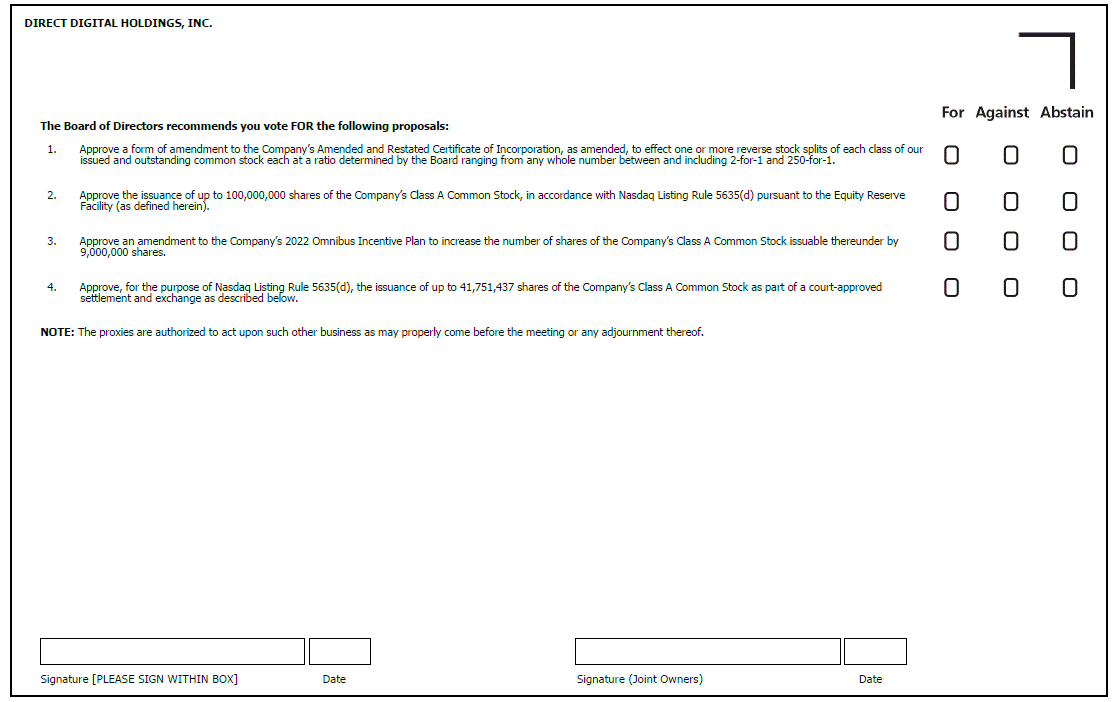
1.Approve a form of amendment to the Company’s Amended and Restated Certificate of Incorporation, as amended, to effect one or more reverse stock splits of each class of our issued and outstanding common stock each at a ratio ranging from any whole number between and including 2-for-1 and 250-for-1 (with our Board of Directors being authorized to determine the exact ratio for each reverse stock split), with any such reverse stock split to be effected at such time and date before December 26, 2026, if at all, as determined by the Board in its sole discretion;
2.Approve the issuance of up to 100,000,000 shares of the Company’s Class A Common Stock, in accordance with Nasdaq Listing Rule 5635(d) pursuant to the Equity Reserve Facility (as defined herein);
3.Approve an amendment to the Company’s 2022 Omnibus Incentive Plan to increase the number of shares of the Company’s Class A Common Stock issuable thereunder by 9,000,000 shares;
4.Approve, for the purpose of Nasdaq Listing Rule 5635(d), the issuance of up to 41,751,437 shares of the Company’s Class A Common Stock as part of a court-approved settlement and exchange as described below; and
5.Transact any other business that may properly come before the Special Meeting or any adjournment of the Special Meeting.
We will hold our Special Meeting in virtual format only, via live audio webcast at the date and time specified above, instead of holding the meeting at any physical location. Only those stockholders of record as of the close of business on the record date of November 26, 2025 are entitled to vote at the Special Meeting or any postponements or adjournments thereof. A complete list of stockholders entitled to vote at the Special Meeting will be available for your inspection beginning December 12, 2025, at our offices located at 1177 West Loop South, Suite 1310, Houston, Texas 77027, between the hours of 10:00 a.m. and 5:00 p.m., Central Time, each business day during the 10 days preceding the Special Meeting, however, if we determine that a physical in-person inspection is not practicable, such list of stockholders may be made available electronically, upon request. You or your proxyholder may participate, vote, and examine our stockholder list at the Special Meeting by visiting www.virtualshareholdermeeting.com/DRCT2025SM2 and using your 16-digit control number.
Please note the technical requirements for virtual attendance at the Special Meeting, as described in the enclosed proxy statement under the heading “Questions and Answers.”
IMPORTANT NOTICE REGARDING AVAILABILITY OF PROXY MATERIALS. THIS PROXY STATEMENT AND THE ENCLOSED PROXY CARD ARE BEING MAILED TO OUR STOCKHOLDERS ON OR ABOUT DECEMBER 15, 2025. In accordance with the rules of the Securities and Exchange Commission (the “SEC”), we are advising our stockholders of the availability on the internet of our proxy materials related to our forthcoming Special Meeting. Because we have elected to utilize the “full set delivery” option, we are delivering to all stockholders paper copies of all of the proxy materials, as well as providing access to those proxy materials on a publicly accessible website. This Notice of Special Meeting and Proxy Statement are available to holders of our common stock at www.proxyvote.com and on our corporate website www.directdigitalholdings.com. These proxy materials will be available free of charge.
YOUR VOTE IS IMPORTANT!
Submitting your proxy card or voting over the Internet does not affect your right to vote virtually if you decide to virtually attend the Special Meeting. You are urged to submit your proxy as soon as possible, regardless of whether or not you expect to virtually attend the Special Meeting. You may revoke your proxy at any time before it is voted at the Special Meeting by (i) delivering written notice to our Corporate Secretary, Diana P. Diaz, at our address above, (ii) submitting a later-dated proxy card or voting over the Internet or mobile device at a later time, or (iii) virtually attending the Special Meeting and voting. No revocation under (i) or (ii) will be effective unless written notice or the proxy card or updated vote over the Internet or mobile device is received by our Corporate Secretary at or before the Special Meeting.
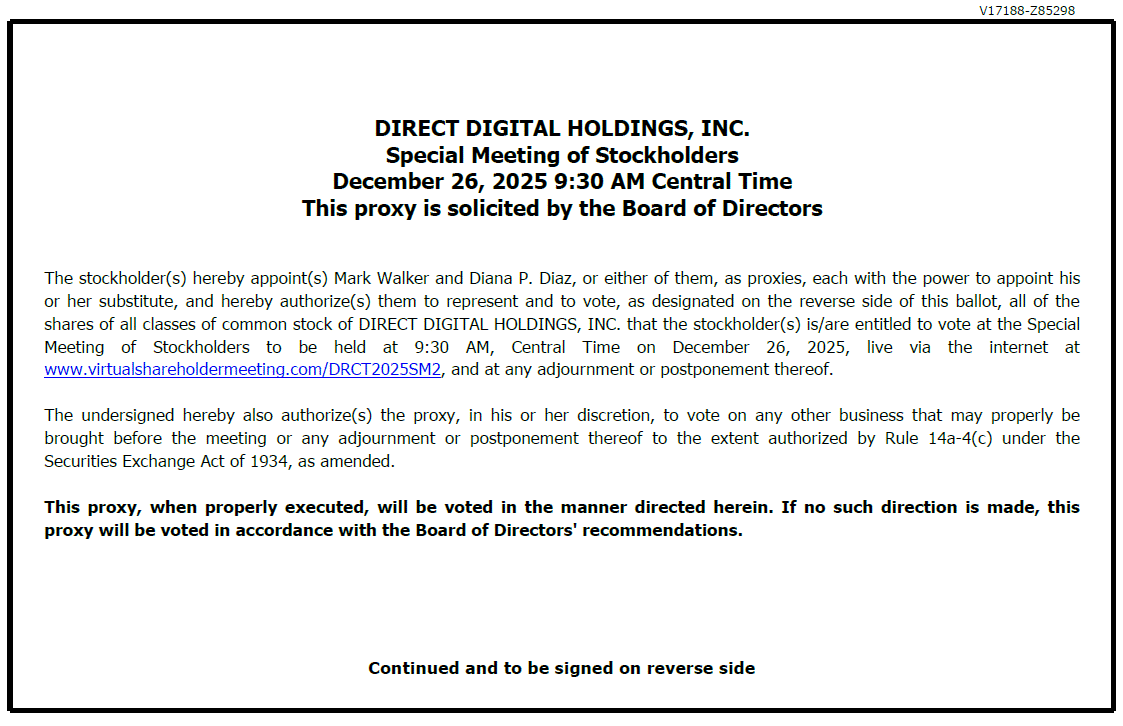
When you submit your proxy, you authorize Mark Walker, our Chief Executive Officer, and Diana P. Diaz, our Chief Financial Officer, or their designees, to vote your shares at the Special Meeting and on any adjournments of the Special Meeting in accordance with your instructions.
By Order of the Board of Directors,
Diana P. Diaz
Corporate Secretary
December 15, 2025
Houston, Texas
DIRECT DIGITAL HOLDINGS, INC.
1177 West Loop South, Suite 1310
Houston, Texas 77027
Phone: (832) 402-1051
PROXY STATEMENT
This proxy statement is being mailed, beginning on or about December 15, 2025, to the holders of shares of common stock of Direct Digital Holdings, Inc. (the “Company,” “our,” “we,” or “Direct Digital”) as of November 26, 2025, in connection with the solicitation of proxies by our Board of Directors (our “Board”) for our 2025 Special Meeting of Stockholders (the “Special Meeting”).
The Special Meeting can be accessed by visiting www.virtualshareholdermeeting.com/DRCT2025SM2 on Friday, December 26, 2025 at 9:30 a.m., Central Time. Our Board encourages you to read this document thoroughly and take this opportunity to vote, via proxy, on the matters to be decided at the Special Meeting. This proxy procedure is necessary to permit all stockholders, some of whom may be unable to attend the Special Meeting virtually, to vote on the matters described in this proxy statement. As discussed below, you may revoke your proxy at any time before your shares are voted at the Special Meeting.
TABLE OF CONTENTS
| | | | | |
| |
| |
| |
PROPOSAL NO. 2 APPROVAL OF THE ISSUANCE OF 100,000,000 SHARES OF CLASS A COMMON STOCK, IN ACCORDANCE WITH NASDAQ LISTING RULE 5635(D), PURSUANT TO THE EQUITY RESERVE FACILITY | |
PROPOSAL NO. 3 APPROVAL OF AN AMENDMENT TO THE COMPANY’S 2022 OMNIBUS INCENTIVE PLAN TO INCREASE THE NUMBER OF SHARES OF THE COMPANY’S CLASS A COMMON STOCK ISSUABLE THEREUNDER | |
PROPOSAL NO. 4 APPROVAL, FOR THE PURPOSE OF NASDAQ LISTING RULE 5635(D), OF THE ISSUANCE OF 41,751,437 SHARES OF CLASS A COMMON STOCK AS PART OF A COURT-APPROVED SETTLEMENT AND EXCHANGE | |
| |
| |
| |
| |
| |
Certificate of Amendment to the Amended and Restated Certificate of Incorporation | Annex A |
QUESTIONS AND ANSWERS
Q: What is the purpose of the Special Meeting?
A: At the Special Meeting, our stockholders will act upon the matters outlined in the Notice of Special Meeting of Stockholders accompanying this proxy statement, including to (i) approve a form of amendment to the Company’s Amended and Restated Certificate of Incorporation, as amended (the “Certificate of Incorporation”), to effect one or more reverse stock splits of each class of our issued and outstanding common stock each at a ratio ranging from any whole number between and including 2-for-1 and 250-for-1 (with our Board of Directors (the “Board”) being authorized to determine the exact ratio for each reverse stock split), with any such reverse stock split to be effected at such time and date before December 26, 2026, if at all, as determined by the Board in its sole discretion (any such reverse stock split, the “Reverse Split” and any such amendment with the terms approved by the Board, the “Amendment”), as described in detail below, (ii) approve the issuance of up to 100,000,000 shares of the Company’s Class A Common Stock, in accordance with Nasdaq Listing Rule 5635(d) pursuant to the Equity Reserve Facility (as defined herein) (the “Equity Reserve Facility Issuance Proposal”), (iii) approve an amendment to the Company’s 2022 Omnibus Incentive Plan to increase the number of shares of the Company’s Class A Common Stock issuable thereunder by 9,000,000 shares (the “Equity Plan Amendment”), (iv) approve, for the purpose of Nasdaq Marketplace Rule 5635(d), the issuance of up to 41,751,437 shares of Class A Common Stock as part of a court-approved settlement and exchange as described below (the “Settlement Issuance Proposal”) and (v) transact any other business that may properly come before the Special Meeting or any adjournment thereof.
Q: How can I attend the Special Meeting and why is the Company holding the Special Meeting in a virtual only format?
A: We are holding the Special Meeting in a virtual format, rather than a meeting at any physical location, in order to encourage attendance and participation by a broader group of stockholders, while also reducing the costs and environmental impact associated with an in-person meeting.
To attend and participate in the Special Meeting, stockholders will need to access the live audio webcast of the meeting. To do so, stockholders of record will need to visit www.virtualshareholdermeeting.com/DRCT2025SM2 and use their 16-digit Control Number provided in your proxy card to log in to this website, and beneficial owners of shares held in street name will need to follow the instructions provided by the bank, brokerage firm or other nominee that holds his, hers or its shares. We encourage stockholders to log in to this website and access the webcast before the Special Meeting’s start time. Further instructions on how to attend, participate in and vote at the Special Meeting, including how to demonstrate your ownership of our stock as of the record date, are available at www.virtualshareholdermeeting.com/DRCT2025SM2. Please note you will only be able to attend and vote in the meeting using this website. All references to attending the Special Meeting “in person” in this Proxy Statement mean attending the live webcast at the Special Meeting.
Q: How do I submit questions at the Special Meeting?
A: We are committed to engagement with our stockholders. You will be able to submit questions during our Special Meeting by visiting www.virtualshareholdermeeting.com/DRCT2025SM2. While we will try to answer stockholder-submitted questions that comply with the meeting rules of conduct as determined by the chair of the meeting, we may not be able to answer questions due to time constraints. However, we reserve the right to edit profanity or other inappropriate language, or to exclude questions that are not pertinent to meeting matters or that are otherwise inappropriate. If we are unable to answer the questions at the Special Meeting, subject to Delaware law, we will reserve our answers for individual outreach following the meeting.
Q: Who is entitled to vote at our Special Meeting?
A: The record holders of each of our Class A Common Stock, par value $0.001 per share (the “Class A Common Stock”) and our Class B Common Stock, par value $0.001 per share (the “Class B Common Stock,” and together with our Class A Common Stock, the “Common Stock”), as well as the holders of share of our Series A Convertible Preferred Stock (the “Series A Preferred Stock”) (on an as-converted basis) at the close of business on the record date, November 26, 2025, may vote at the Special Meeting. Each share of Class A Common Stock and Class B Common Stock entitles the holder thereof to one vote on all matters submitted to stockholders per share. Each share of Series A Preferred Stock is entitled to vote together with our Common Stock on an as-if-converted-to-Class A-Common-Stock basis determined by dividing the aggregate Accumulated Conversion Value of all shares of Series A Preferred Stock held by each Holder, by the Conversion Price (as each such term is defined in the Certificate of Designation for the Series A Preferred Stock filed with the Delaware Secretary of State (the “Certificate of Designation”)). Accordingly, a Holder of Series A Preferred Stock is entitled to one vote for each whole share of Class A Common Stock into which their shares of Series A Preferred Stock are then-convertible on all matters submitted to a vote of stockholders of the Company. There were 31,687,949 shares of Class A Common Stock, 9,575,500 shares of Class B Common Stock and 30,180 shares of Series A Preferred Stock outstanding (for which the 30,180 shares are entitled to 12,072,000 votes on any matter presented to the common stockholders) on the record date and entitled to vote at the Special Meeting. All shares of Class B Common Stock are held by Direct Digital Management, LLC (“DDM”), a Delaware limited liability company indirectly owned by Mark Walker, our Chairman and Chief Executive Officer, and Keith Smith, our President. A list of stockholders entitled to vote at the Special Meeting, including the address of and number of shares held by each stockholder of record, will be available for your inspection beginning December 15, 2025, at our offices located at 1177 West Loop South, Suite 1310, Houston, Texas 77027, between the hours of 10:00 a.m. and 5:00 p.m., Central Time, each business day during the 10 days preceding the Special Meeting, however, if we determine that a physical in-person inspection is not practicable, such list of stockholders may be made available electronically, upon request.
Stockholders of Record: Shares Registered in Your Name. If on the record date your shares were registered directly in your name with our transfer agent, Equiniti, then you are a stockholder of record. As a stockholder of record, you may vote virtually at the Special Meeting or vote by proxy. Whether or not you plan to virtually attend the Special Meeting, we urge you to vote over the Internet or by mobile device, fill out and return the proxy card enclosed therewith, to ensure your vote is counted.
Beneficial Owner: Shares Registered in the Name of a Bank, Brokerage Firm, Custodian or Other Nominee. If on the record date your shares were held in an account at a bank, brokerage firm or other nominee, then you are the beneficial owner of shares held in “street name” and these proxy materials are being forwarded to you by that organization. The organization holding your account is considered the stockholder of record for purposes of voting at the Special Meeting. As a beneficial owner, you have the right to direct your bank, brokerage firm or other nominee on how to vote the shares in your account. You are also invited to virtually attend the Special Meeting.
Q: How do I vote?
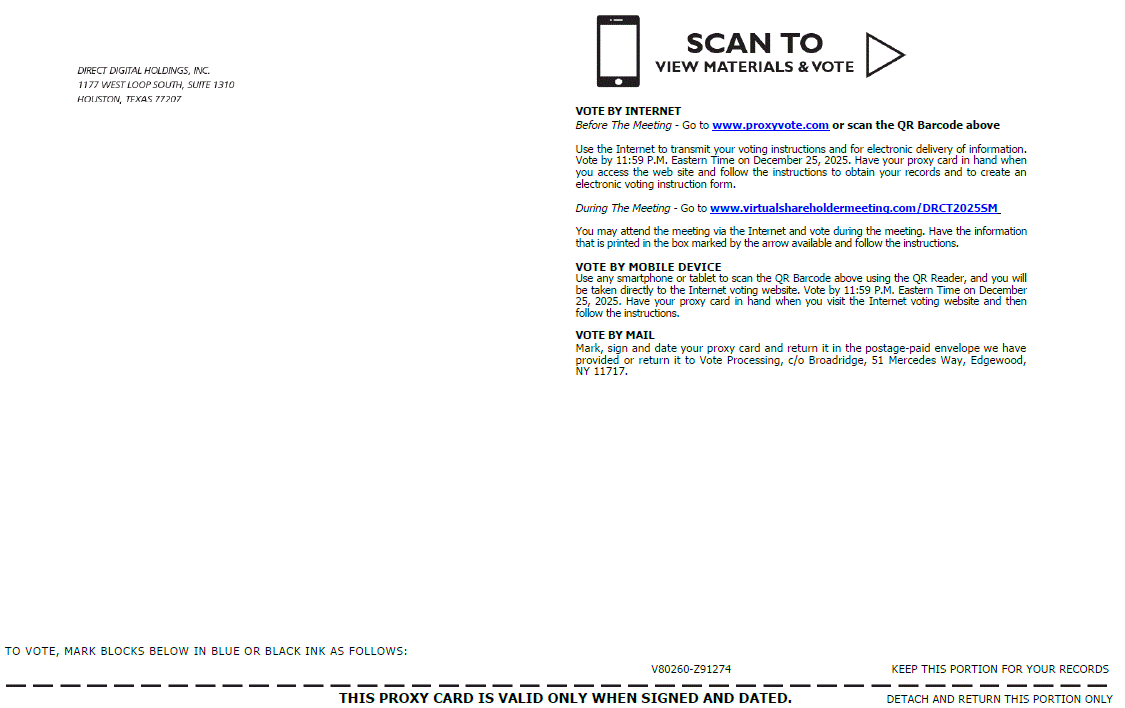
A: You may vote during the Special Meeting by following the instructions posted at www.proxyvote.com and entering your 16-digit control number included with your proxy card or via internet or by mobile device as indicated in the proxy card.
Whether you hold shares directly as the stockholder of record or indirectly as the beneficial owner of shares held for you by a bank, brokerage firm or other nominee (i.e., in “street name”), you may direct your vote without attending the Special Meeting. You may vote by granting a proxy or, for shares you hold in street name, by submitting voting instructions to your bank, brokerage firm or other nominee. In most instances, you will be able to do this by internet, mobile device or by mail. Please refer to the summary instructions below and those included on your proxy card or, for shares you hold in street name, the voting instruction card provided by your bank, brokerage firm or other nominee.
By Internet - If you have Internet access, you may authorize your proxy from any location in the world as directed in the proxy card.
By Mobile Device – If you choose to vote by mobile device, scan the QR code imprinted on the proxy card using either a smartphone or tablet and you will be taken directly to the Internet Voting site.
By Mail - You may authorize your proxy by signing your proxy card and mailing it in the enclosed, postage-prepaid and addressed envelope. For shares you hold in street name, you may sign the voting instruction card included by your bank, brokerage firm or other nominee and mail it in the envelope provided.
Q: What if I have technical difficulties or trouble accessing the virtual Special Meeting?
A: We will have technicians ready to assist you with any technical difficulties you may have accessing the virtual Special Meeting. If you encounter any difficulties accessing the virtual Special Meeting during the check-in or meeting time, please call the technical support number located on the meeting page. Technical support will be available starting at approximately 9:15 a.m., Central Time, on Friday, December 26, 2025.
Q: What is a proxy?
A: A proxy is a person you appoint to vote your shares on your behalf. If you are unable to virtually attend the Special Meeting, our Board is seeking your appointment of a proxy so that your shares may be voted. If you vote by proxy, you will be designating Mark Walker, our Chief Executive Officer, and Diana P. Diaz, our Chief Financial Officer, as your proxies. Mr. Walker and/or Ms. Diaz may act on your behalf and have the authority to appoint a substitute to act as your proxy.
Q: How will my shares be voted if I vote by proxy?
A: Your proxy will be voted according to the instructions you provide. If you complete and submit your proxy but do not otherwise provide instructions on how to vote your shares, your shares will be voted (i) “FOR” the approval of a form of Amendment for one or more Reverse Splits each at a range of ratios determined by the Board and timing parameters described herein, (ii) “FOR” the approval of the Equity Reserve Facility Issuance Proposal, (iii) “FOR” the approval of the Equity Plan Amendment, and (iv) “FOR” the approval of the Settlement Issuance Proposal. Presently, our Board does not know of any other matter that may come before the Special Meeting. However, your proxies are authorized to vote on your behalf, using their discretion, on any other business that properly comes before the Special Meeting.
Q: How do I revoke my proxy?
A: You may revoke your proxy at any time before your shares are voted at the Special Meeting by:
•Sending a written notice that you are revoking your proxy to Diana P. Diaz, at our address above (so long as we receive such notice no later than the close of business on the day before the Special Meeting);
•Submitting a later-dated proxy card or voting again via the Internet or mobile device; or
•Virtually attending the Special Meeting and notifying the election officials at the Special Meeting that you wish to revoke your proxy and vote virtually. Simply attending the Special Meeting will not, by itself, revoke your proxy.
If your shares are held by your bank, brokerage firm or other nominee, you should follow the instructions provided by such bank, brokerage firm or other nominee.
Q: Is my vote confidential?
A: Yes. All votes remain confidential.
Q: What constitutes a quorum at the Special Meeting?
A: In accordance with Delaware law (the law under which we are incorporated) and our Bylaws, holders of a majority of the voting power of the outstanding shares of stock entitled to vote at such meeting constitutes a quorum, thereby permitting the stockholders to conduct business at the Special Meeting. Abstentions, votes withheld, and broker non-votes will be included in the calculation of the number of shares considered present at the Special Meeting for purposes of determining the existence of a quorum.
If a quorum is not present at the Special Meeting, a majority of the stockholders present virtually and by proxy may adjourn the meeting to another date. If an adjournment is for more than 30 days or if after an adjournment a new record date is fixed for the adjourned meeting by our Board, we will provide notice of the adjourned meeting to each stockholder of record entitled to vote at the adjourned meeting. At any adjourned meeting at which a quorum is present, any business may be transacted that might have been transacted at the originally called meeting.
Q: What is a “broker non-vote”?
A: Broker non-votes occur when shares are held indirectly through a bank, brokerage firm or other nominee or intermediary on behalf of a beneficial owner (referred to as held in “street name”) and the broker submits a proxy, but does not cast a vote on a matter because the broker has not received voting instructions from the beneficial owner, and (i) the broker does not have discretionary voting authority on the matter or (ii) the broker chooses not to vote on a matter for which it has discretionary voting authority. Pursuant to the rules of the New York Stock Exchange (“NYSE”), which governs brokers’ use of discretionary authority, brokers are permitted to exercise discretionary voting authority only on “routine” matters when voting instructions have not been timely received from a beneficial owner. Proposal No. 1 is considered a routine matter for which brokers, banks or other nominees may vote uninstructed shares. Because brokers have discretionary authority to vote in the absence of instructions, we do not expect any broker non-votes for Proposal No. 1. On the other hand, absent instructions from the beneficial owner of such shares, a broker is not entitled to vote shares held for a beneficial owner on Proposal No. 2, Proposal No. 3 or Proposal No. 4, each a non-routine matter.
Q: What vote is required to approve an amendment to the Company’s Certificate of Incorporation to effect a reverse stock split?
A: The affirmative vote of the holders of the majority of the votes cast with respect to the Company’s Class A Common Stock and Class B Common Stock, and the Series A Preferred Stock, voting together as a single class, is required to approve the form of amendment to the Company’s Certificate of Incorporation to effect one or more Reverse Splits described herein (which is subject to the discretion of the Board as to implementation and ratio within the parameters described herein). Abstentions and broker non-votes will have no effect on this proposal. Because brokers have discretionary authority to vote on this proposal, we do not expect any broker non-votes in connection with this proposal.
Q: What vote is required to approve the Equity Reserve Facility Issuance Proposal?
A: The affirmative vote of a majority of the voting power of the shares present, virtually at the Special Meeting or by proxy, and entitled to vote at the Special Meeting is required to approve the Equity Reserve Facility Issuance Proposal. Abstentions will have the same effect as a vote “AGAINST” this proposal. However, broker non-votes will have no effect on the vote for this proposal as they are not considered to be present and entitled to vote on this matter.
Q: What vote is required to amend the Company’s 2022 Omnibus Incentive Plan to increase the number of shares of the Company’s Class A Common Stock issuable thereunder?
A: The affirmative vote of a majority of the voting power of the shares present, virtually at the Special Meeting or by proxy, and entitled to vote at the Special Meeting is required to amend the Company’s 2022 Omnibus Incentive Plan to increase the number of shares of the Company’s Class A Common Stock issuable thereunder. Abstentions will have
the same effect as a vote “AGAINST” this proposal. However, broker non-votes will have no effect on the vote for this proposal as they are not considered to be present and entitled to vote on this matter.
Q: What vote is required to approve the Settlement Issuance Proposal?
A: The affirmative vote of a majority of the voting power of the shares present, virtually at the Special Meeting or by proxy, and entitled to vote at the Special Meeting is required to approve the Settlement Issuance Proposal. Abstentions will have the same effect as a vote “AGAINST” this proposal. However, broker non-votes will have no effect on the vote for this proposal as they are not considered to be present and entitled to vote on this matter.
Q: What percentage of our outstanding Class A Common Stock and Class B Common Stock do our directors, executive officers, and 5% beneficial owners own?
A: As of November 14, 2025, our directors, executive officers, and 5% beneficial owners collectively owned, or had the right to acquire, approximately 3.1% of our outstanding Class A Common Stock and 100% of our Class B Common Stock. Because the holders of our Class A Common Stock and Class B Common Stock vote together as a single class, this means our directors, executive officers and 5% beneficial owners control approximately 25.6% of the voting power of the Company. See the discussion under the heading “Stock Ownership of Our Directors, Executive Officers, and 5% Beneficial Owners” on page 7 for more details. Our directors, executive officers and 5% beneficial owners do not own any of the Series A Preferred Stock. Q: How does the board of directors recommend that I vote my shares?
A: As to the proposals to be voted on at the Special Meeting, our board of directors unanimously recommends that you vote:
•“FOR” Proposal No. 1, the approval of a form of amendment to our Certificate of Incorporation to effect one or more Reverse Splits;
•“FOR” Proposal No. 2, the approval of the Equity Reserve Facility Issuance Proposal;
•“FOR” Proposal No. 3, the approval of the Equity Plan Amendment; and
•“FOR” Proposal No. 4, the approval of the Settlement Issuance Proposal.
STOCK OWNERSHIP OF OUR DIRECTORS, EXECUTIVE OFFICERS,
AND 5% BENEFICIAL OWNERS
The following table sets forth the beneficial ownership of our Class A Common Stock and Class B Common Stock, as of November 14, 2025 (the “Determination Date”) by:
•each person, or group of affiliated persons, who is known to beneficially own more than 5% of either our Class A Common Stock or our Class B Common Stock;
•each of our named executive officers for fiscal year 2024 shown in our Summary Compensation Table in our most recent proxy statement for our 2025 annual meeting of stockholders;
•each of our current directors; and
•all of our current directors and executive officers as a group.
None of the individuals above own any shares of Series A Preferred Stock. As of the Determination Date, there were 31,687,949 shares of our Class A Common Stock outstanding and 9,575,500 shares of our Class B Common Stock outstanding. As described in the section titled “Related-Person Transactions” above, DDM is entitled to have its LLC Units redeemed for shares of Class A Common Stock on a one-for-one basis (subject to customary adjustments, including for stock splits, stock dividends and reclassifications) in accordance with the terms of the DDH LLC Agreement; provided that, at our election, we may effect a direct exchange of such Class A Common Stock. In connection with our initial public offering, we issued to DDM one share of Class B Common Stock for each LLC Unit it owns.
Beneficial ownership is determined in accordance with the rules of the SEC. These rules generally attribute beneficial ownership of securities to persons who possess sole or shared voting power or investment power with respect to such securities, including options and warrants that are currently exercisable or exercisable within 60 days of the Determination Date. Shares of our Class A Common Stock issuable pursuant to stock options are deemed outstanding for computing the percentage of the person holding such options and the percentage of any group of which the person is a member but are not deemed outstanding for computing the percentage of any other person. Except as indicated by the footnotes below, we believe, based on the information furnished to us, that the persons named in the table below have sole voting and investment power with respect to all shares of Class A Common Stock shown that they beneficially own, subject to community property laws where applicable. The information does not necessarily indicate beneficial ownership for any other purpose, including for purposes of Section 13(d) and 13(g) of the Exchange Act. “Voting power” is the power to vote or direct the voting of shares and “investment power” includes the power to dispose or direct the disposition of shares.
Unless otherwise indicated, the address for each director and executive officer listed is: c/o Direct Digital Holdings, Inc., 1177 West Loop South, Suite 1310, Houston, Texas 77027.
| | | | | | | | | | | | | | | | | | | | | | | | | | | | | | | | | | | |
| Shares of Class A Common Stock Beneficially Owned | | Shares of Class B Stock Beneficially Owned | | Total Voting Power Beneficially Owned |
| No. (4) | | Percent | | No. | | Percent | | No. | | Percent |
5% Stockholders | | | | | | | | | | | |
Direct Digital Management, LLC(1) | — | | — | | 9,575,500 | | 100% | | 9,575,500 | | 23.2% |
| | | | | | | | | | | |
Named Executive Officers and Directors | | | | | | | | | | | |
Mark Walker, Chairman and Chief Executive Officer | 80,840 | (3) | *% | | 4,981,500 | (2) | 52% | | 5,062,340 | | 12.3% |
Keith Smith, President and Director | 604,268 | (4) | 1.9% | | 4,594,000 | (2) | 48% | | 5,198,268 | | 12.6% |
Diana P. Diaz, Chief Financial Officer | 27,044 | (5) | * | | — | | — | | 27,044 | | * |
Richard Cohen, Director | 70,302 | | * | | — | | — | | 70,302 | | * |
Antoinette R. Leatherberry, Director | 74,442 | | * | | — | | — | | 74,442 | | * |
Mistelle Locke, Director | 40,447 | | * | | — | | — | | 40,447 | | * |
All executive officers and directors as a group (8 persons) | 976,822 | (6) | 3.1 % | | 9,575,500 | | 10 % | | 10,552,322 | | 25.6 % |
*Less than 1%
(1)Direct Digital Management, LLC is a holding company in which Mark Walker, our Chairman and Chief Executive Officer, and Keith Smith, our President, each indirectly hold an approximately 50% economic and voting interest, as adjusted for redemptions of LLC Units in exchange for shares of Class A Common Stock of the Company. AJN Energy & Transport Ventures, LLC and SKW Financial LLC directly hold the equity interests in Direct Digital Management, LLC. Mr. Walker and his wife share voting and dispositive power with respect to the shares of Class B Common Stock held by AJN Energy & Transport Ventures, LLC. Mr. Smith and his wife share voting and dispositive power with respect to the shares of Class B Common Stock held by SKW Financial LLC.
(2)Consists of the shares owned by Direct Digital Management, LLC. Each of Messrs. Walker and Smith indirectly hold an approximately 50% economic and voting interest in Direct Digital Management, LLC, as adjusted for redemptions of LLC Units in exchange for shares of Class A Common Stock of the Company. AJN Energy & Transport Ventures, LLC and SKW Financial LLC directly hold the equity interests in Direct Digital Management, LLC. Mr. Walker and his wife share voting and dispositive power with respect to the shares of Class B Common Stock held by AJN Energy & Transport Ventures, LLC. Mr. Smith and his wife share voting and dispositive power with respect to the shares of Class B Common Stock held by SKW Financial LLC.
(3)Includes: 80,840 shares of Class A Common Stock that can be acquired by Mr. Walker upon the exercise of stock options that are vested or vesting within 60 days of the Measurement Date.
(4)Includes: 80,840 shares of Class A Common Stock that can be acquired by Mr. Smith upon the exercise of stock options that are vested or vesting within 60 days of the Measurement Date.
(5)Includes: 12,433 shares of Class A Common Stock that can be acquired by Ms. Diaz upon the exercise of stock options that are vested or vesting within 60 days of the Measurement Date.
(6)Includes: 212,883 shares of Class A Common Stock that can be acquired by all executive officers and directors upon the exercise of stock options that are vested or vesting within 60 days of the Measurement Date.
PROPOSAL NO. 1
APPROVAL OF A FORM OF AMENDMENT TO THE AMENDED AND RESTATED CERTIFICATE OF INCORPORATION, AS AMENDED, TO EFFECT ONE OR MORE REVERSE STOCK SPLITS
The Board is submitting to the stockholders for approval of a form of amendment to the Company’s Certificate of Incorporation, to effect a one or more reverse stock splits (any such reverse stock split, the “Reverse Split”) of the Company’s issued and outstanding Common Stock each at a ratio of not less than 2-for-1 and not greater than 250-for-1, with the exact ratio for any such Reverse Split to be determined at the sole discretion of the Board and with such Reverse Split to be effected at such time and date before December 26, 2026, if at all, as determined by the Board in its sole discretion (any such amendment individually, the “Amendment,” and collectively, the “Amendments”). If approved, and deemed necessary by the Board, an Amendment will be effective upon the filing of a certificate of amendment to our Amended and Restated Certificate of Incorporation, or at such other date and time as may be specified in such certificate, in substantially the form attached to this proxy statement as Annex A (the “Certificate of Amendment”), with the Secretary of State of Delaware, with the timing of such filing to occur, if at all, at the sole discretion of the Board. The form of Certificate of Amendment will then be deemed approved by stockholders and may be used by the Board, in its discretion, to effect one or more reverse stock splits within the ratios described herein by the filing of the applicable Certificate of Amendment as described above.
All shares of our Common Stock have equal rights and privileges with respect to voting, liquidation and dividend rights. Each share entitles the holder thereof to one non-cumulative vote for each share held of record on all matters submitted to a vote of the stockholders and to participate equally and to receive any and all such dividends as may be declared by the Board, subject to the payment of all dividends on our Series A Convertible Preferred Stock (the “Series A Preferred Stock”). Holders of our Common Stock have no preemptive rights to acquire additional shares of common stock or any other securities. The Common Stock is not subject to redemption and carries no subscription or conversion rights.
If this proposal is approved by our stockholders, the Board will have the authority, in its sole discretion, without further action by our stockholders, to effect one or more Amendments. Even if our stockholders approve the Amendments, we reserve the right not to effect a Reverse Split if the Board does not deem it to be in the best interests of our stockholders. Upon implementation of an Amendment, depending on the ratio of not less than 2-for-1 and not greater than 250-for-1 for any Reverse Split, the applicable number of shares of outstanding Class A Common Stock and Class B Common Stock will be automatically converted into one share of Class A Common Stock and Class B Common Stock, as applicable. We will effect a Reverse Split, if approved, at the same ratio for both the Class A Common Stock and the Class B Common Stock. The number of shares of Class A Common Stock underlying outstanding equity awards and available for future awards under our equity incentive plans would also be proportionately reduced in the same manner as a result of the Stock Split, as described below.
Purposes of the Amendments
We are submitting this proposal to our stockholders for approval in order to try and increase the trading price of our Class A common stock to help ensure a share price high enough to satisfy the minimum per share bid price requirement for continued listing on The Nasdaq Capital Market. For our Class A Common Stock to continue trading on The Nasdaq Capital Market, we must comply with various listing standards, including maintaining a minimum closing bid price of $1.00 per share pursuant to Nasdaq Listing Rule 5550(a)(2).
On May 12, 2025, the Company received a notice (the “Notice”) from the staff of the Listing Qualifications Department (the “Staff”) of The Nasdaq Stock Market LLC (“Nasdaq”) notifying the Company that because the closing bid price of the Company’s Class A common stock was below $1.00 per share for the prior 30 consecutive business days, the Company was not in compliance with the minimum bid price requirement for continued listing on The Nasdaq Capital Market, as set forth in Nasdaq Listing Rule 5550(a)(2) (the “Bid Price Rule”). The Notice states that the Company has 180 calendar days from the date of the Notice, or until November 10, 2025, to regain compliance with the Bid Price Rule. As of November 10, 2025, the Company was not in compliance with the Bid Price Rule; however, on November 7, 2025, a Nasdaq Hearings Panel (the “Panel”) granted the Company an exception until January 30, 2026, to demonstrate compliance with that rule. If at any time before January 30, 2026, the bid price for the Company’s Class A Common Stock closes at or above $1.00 per share for a minimum of 10 consecutive business days (which number of days may be extended by
Nasdaq), Nasdaq will provide written notification that the Company has achieved compliance with the Bid Price Rule, and the matter will be closed. We believe that a Reverse Split is our best means of increasing and maintaining the price of our common stock to above $1.00 per share in compliance with Nasdaq requirements.
The Board would effect a Reverse Split only upon its determination that the Reverse Split would be in our and our stockholders’ best interests following stockholder approval. If our Board were to effect a Reverse Split, our Board would determine the exact exchange ratio for a Reverse Split (each of which will be with an exchange ratio of not less than 2-for-1 and not greater than 250-for-1), set the timing for a Reverse Split (prior to December 26, 2026) and file the Certificate of Amendment. No further action on the part of stockholders is required to either implement or abandon a Reverse Split. If our Board determines to implement a Reverse Split, we will publicly announce, prior to the effective date of the Reverse Split, additional details regarding the Reverse Split. The Board reserves its right to elect not to proceed, and to abandon, a Reverse Split if it determines, in its sole discretion, that this proposal is no longer in our best interests.
We cannot assure you that a Reverse Split will have any of the desired effects described above. More specifically, we cannot assure you that after a Reverse Split the market price of our common stock will increase proportionately to reflect the ratio for such Reverse Split, that the market price of our Class A Common Stock will not decrease to its pre-split level, or that our market capitalization will be equal to the market capitalization before such Reverse Split.
Potential Risks of the Amendments
Although the principal purpose of a Reverse Split would be to help increase the per-share market price of our Class A Common Stock, there can be no assurance that a Reverse Split will result in any particular price for our Class A Common Stock. If a Reverse Split is effected and the market price of our Class A Common Stock declines, the percentage decline may be greater than would occur in the absence of a Reverse Split. As a result, the trading liquidity of our Class A Common Stock may not necessarily improve. Additionally, there can be no assurance that the market price per share of our Class A Common Stock after a Reverse Split will increase in proportion to the reduction in the number of shares of our Class A Common Stock outstanding before such Reverse Split. For example, based on the closing price of $0.12 per share of our common stock on December 1, 2025, if a Reverse Split were implemented at a ratio of 20-for-1 (a number within the range of authority sought for approval by stockholders), there can be no assurance that the post-split market price of our common stock would be $2.40 or greater. Accordingly, the total market capitalization of our Class A Common Stock after a Reverse Split may be lower than the total market capitalization before such Reverse Split. Moreover, in the future, the market price of our Class A Common Stock following a Reverse Split may not exceed or remain higher than the market price prior to such Reverse Split.
The number of shares held by each individual holder of Common Stock would be reduced if a Reverse Split is implemented. This may increase the number of stockholders who hold less than a “round lot,” or 100 shares. Odd lot shares may be more difficult to sell, and brokerage commissions and other costs of transactions in odd lots are generally somewhat higher than the costs of transactions in “round lots” of even multiples of 100 shares. Consequently, a Reverse Split could increase the transaction costs to existing holders of Common Stock in the event they wish to sell all or a portion of their position.
Additionally, the liquidity of our Class A Common Stock could be affected adversely by the reduced number of shares outstanding after a Reverse Split. Although our Board believes that a higher stock price may help generate investor interest, there can be no assurance that a Reverse Split will result in a per share price that will attract institutional investors or investment funds or that such share price will satisfy the investing guidelines of institutional investors or investment funds. As a result, the decreased liquidity that may result from having fewer shares outstanding may not be offset by increased investor interest in our common stock. The market price of our Class A Common Stock will also be based on our performance and other factors, some of which are unrelated to the number of shares outstanding.
The Board intends to effect a Reverse Split only if it believes that a decrease in the number of shares is likely to improve the trading price of our Class A Common Stock and if the implementation of a Reverse Split is determined by the Board to be in the best interests of the Company and its stockholders. If neither of these conditions is present, then the Board will not proceed with a Reverse Split.
Potential Consequences if a Reverse Split Proposal is Not Approved
If a Reverse Split is not approved by our stockholders, our Board will not have the authority to effect an Amendment to, among other things, facilitate the continued listing of our Class A Common Stock on Nasdaq by increasing the per share trading price of our Class A Common Stock to help ensure a share price high enough to satisfy the $1.00 per share minimum bid price requirement. Any inability of our Board to effect a Reverse Split could expose us to delisting by Nasdaq.
Effecting a Reverse Split
Upon receipt of stockholder approval for an Amendment, if our Board concludes that it is in the best interests of our Company and our stockholders to effect a Reverse Split, a Certificate of Amendment will be filed with the Secretary of State of Delaware. The actual timing of the filing of the Certificate of Amendment with the Secretary of State of Delaware to effect a Reverse Split, will be determined by our Board, but prior to December 26, 2026. In addition, if for any reason our Board deems it advisable to do so, a Reverse Split may be abandoned at any time prior to the filing of the Certificate of Amendment, without further action by our stockholders. The Amendment will be effective as of the date of filing with the Secretary of State of the State of Delaware or at such other date and time as is specified in the Certificate of Amendment (the “Effective Time”).
Except as explained below with respect to fractional shares (see “—Principal Effects of a Reverse Split – Treatment of Fractional Shares”), at the Effective Time, all shares of our Common Stock issued and outstanding immediately prior to the Effective Time will be combined, automatically and without any action on the part of stockholders, into a lesser number of shares of our Common Stock calculated in accordance with the reverse stock split ratio determined by the Board. After the Effective Time, our Common Stock will have a new committee on uniform securities identification procedures (“CUSIP”) number, which is a number used to identify the Company’s equity securities, and stock certificates with the older CUSIP number will need to be exchanged for stock certificates with the new CUSIP number by following the procedures described below.
Principal Effects of a Reverse Split
Common Stock
Our Certificate of Incorporation provides that in no event will any reverse stock split be declared or made on any class of Common Stock unless (a) a corresponding reverse stock split is made for all other classes of outstanding Common Stock in the same proportion and the same manner and (b) the adjustment has been reflected in the same economically equivalent manner on all LLC Units (as defined below). If a Reverse Split is approved and effected, each holder of our Class A Common Stock and Class B Common Stock outstanding immediately prior to the effectiveness of the Reverse Split will own fewer shares of our Class A Common Stock or Class B Common Stock, as applicable, upon effectiveness of the Reverse Split. Split shares issued in connection with the Reverse Split will be fully paid and non-assessable. The number of stockholders is expected to remain unchanged as a result of the Reverse Split. A Reverse Split will decrease the number of outstanding shares of our Common Stock, but will not affect any stockholder’s proportionate interest in our Company, except for possible differences resulting from the treatment of any fractional as a result of a Reverse Split. The par value per share of each class of our Common Stock will remain unchanged. While the aggregate par value per share of each class of our outstanding Common Stock will be decreased, our additional paid-in capital will be increased by a corresponding amount. Therefore, a Reverse Split will not affect our total stockholders’ equity. All share and per share information included in our financial statements will be retroactively adjusted to reflect a Reverse Split for all periods presented in our future financial reports and regulatory filings.
Any Reverse Split is likely to result in some stockholders owning “odd−lots” of fewer than 100 shares of Common Stock. Brokerage commissions and other costs of transactions in odd lots are generally somewhat higher than the costs of transactions on “round−lots” of even multiples of 100 shares.
There will be no change to the authorized capital of the Company as a result of a Reverse Split, which will remain at 760,000,000 shares of Class A Common stock, 20,000,000 shares of Class B Common Stock, and 10,000,000 shares of preferred stock, with the par value of $0.001 per share (the “Preferred Stock”). Although the number of authorized shares of our capital stock will not change as a result of a Reverse Split, the number of shares of our Common Stock issued and outstanding will be reduced in proportion to the ratio selected by the Board. Thus, a Reverse Split will effectively increase the number of authorized and unissued shares of our Common Stock available for future issuance by the amount of the reduction effected by such Reverse Split. The Company will retain the corporate authority to issue in the future up to all
such additional remaining shares of authorized but unissued Common Stock. These shares may be issued without stockholder approval at any time in the sole discretion of our Board. The authorized and unissued shares may be issued for cash, to acquire property or for any other purpose that is deemed in the best interests of our Company. Any decision to issue additional shares will reduce the percentage of our stockholders’ equity held by our current stockholders and could dilute our net tangible book value.
Our authorized and unissued shares could possibly be used by management to oppose a hostile takeover attempt, delay or prevent changes of control, or changes in or removal of management. This could include transactions that are favored by a majority of stockholders, or in which the stockholders might otherwise receive a premium for their shares over then-current market price or benefit stockholders in some other manner. Tender offers or other non-open market acquisitions of stock are usually made at prices above the prevailing market price. In addition, acquisitions of stock by persons attempting to acquire control through market purchases may cause the market price of the stock to reach levels that are higher than would otherwise be the case.
The available authorized and unissued shares of Common Stock give the Company the ability to cause a potential anti-takeover effect by creating potential dilution to the number of outstanding shares. Such dilution will cause a party attempting a takeover to be required to buy more shares of the Company stock and to expend additional resources to accomplish a takeover. A Reverse Split is not part of a plan by management to affect the ability of third parties to take over or change control of the Company, nor are we currently contemplating any such anti-takeover plan.
We will not become a private company as a result of a Reverse Split, and we expect that our Common Stock will continue to be quoted on the Nasdaq Capital Market as a fully reporting company immediately following a Reverse Split, and we plan to continue to file periodic and other reports with the SEC under the Securities Exchange Act of 1934, as amended (the “Exchange Act”).
Our Common Stock is currently registered under Section 12 of the Exchange Act, and we are subject to the periodic reporting requirements of the Exchange Act. A Reverse Split would not affect the registration of our Common Stock under the Exchange Act in any material way.
Issued and Outstanding LLC Interests of Holdings
The Company and Direct Digital Holdings, LLC (“DDH LLC”) have an “Up-C” structure. The DDH LLC Agreement provides that, except as otherwise determined by the Company, as the sole manager of DDH LLC, the Company shall not undertake any reverse stock split of the Class A Common Stock or Class B Common Stock that is not accompanied by an identical combination of the LLC Interests of DDH LLC, to maintain at all times (i) a one-to-one ratio between the number of LLC Interests owned by the Company, directly or indirectly, and the number of outstanding shares of Class A Common Stock, (y) a one-to-one ratio between the number of LLC Interests owned by members of DDH LLC (other than the Company and its subsidiaries) and the number of outstanding shares of Class B Common Stock, or (z) a one-to-one ratio between the number of outstanding other equity interests in the Company and any corresponding equity interests in DDH LLC, in each case, unless such action is necessary to maintain at all times a one-to-one ratio between either the number of LLC Interests owned by the Company, directly or indirectly through its subsidiaries, and the number of outstanding shares of Class A Common Stock or the number of LLC Interests owned by members of DDH LLC (other than the Company and its subsidiaries) and the number of outstanding shares of Class B Common Stock.
Accordingly, pursuant to the DDH LLC Agreement, the consolidation of the Common Stock contemplated by a Reverse Split will be accompanied by an identical consolidation of the LLC Interests, with any resulting fractional interest rounded down to the nearest whole LLC Interest.
Options, Warrants and the Series A Preferred Stock
In addition, all outstanding options and warrants to purchase shares of our common stock and conversion rights under would be adjusted as a result of a Reverse Split, as required by the terms of those securities. In particular, the number of shares issuable upon the exercise of each instrument would be reduced, and the exercise price per share, if applicable, would be increased, in accordance with the terms of each instrument and based on the exchange ratio of a Reverse Split.
Our Board generally has the discretion to determine the appropriate equitable adjustment to outstanding awards and share-based limits under our existing equity incentive plan. Accordingly, if this proposal is approved by our
stockholders and our Board decides to implement a Reverse Split, consistent with the terms of the equity incentive plan and outstanding award agreements, the total number of shares of Class A Common Stock issuable upon exercise, vesting or settlement of such awards and the total number of shares of Class A Common Stock remaining available for future awards under the plan, as well as any share-based limits in the plan, would be proportionately reduced based on the applicable Reverse Split ratio selected by our Board, and any fractional shares that may result therefrom will be rounded down to the nearest whole share. Furthermore, the exercise price of any outstanding options, the purchase price applicable to rights under our equity incentive plan and the stock price per share vesting goals of any equity awards under the plan will be proportionately increased based on the applicable Reverse Split ratio selected by our Board, and any adjusted price that may result therefrom will be rounded up to the nearest whole cent.
If this proposal is approved by our stockholders and our Board decides to implement a Reverse Split, consistent with the terms of the Series A Preferred Stock, the Conversion price as defined under the terms of the Series A Preferred Stock will be multiplied by a fraction of which the numerator will be the number of shares of Class A Common Stock (excluding any treasury shares of the Company) outstanding immediately before a Reverse Split and of which the denominator will be the number of shares of Class A Common Stock outstanding immediately after such Reverse Split (excluding any treasury shares of the Company). Any adjustment to the Conversion Price made pursuant to a Reverse Split will become effective immediately after (i) the record date and (ii) effective date of a Reverse Split.
Treatment of Fractional Shares
We will not issue fractional shares of common stock in connection with a Reverse Split. Stockholders who would otherwise be entitled to receive fractional shares because they hold a number of shares of common stock that is not evenly divided by the reverse split ratio, will be entitled to receive a cash payment, without interest or deduction, rounded to the nearest cent, in an amount equal to the product obtained by multiplying (a) the closing price per share of our common stock as reported on the Nasdaq Stock Market as of the date of the Effective Time of a Reverse Spilt, by (b) the fraction of one share owned by the stockholder.
Effect on Non-Registered Stockholders
Non-registered stockholders holding our Common Stock through a bank, broker or other nominee should note that such banks, brokers or other nominees may have different procedures for processing the consolidation than those that would be put in place by us for registered stockholders. If you hold your shares with such a bank, broker or other nominee and if you have questions in this regard, you are encouraged to contact your nominee.
Book-Entry Shares
The combination of and reduction in the number of our outstanding shares of Common Stock as a result of a Reverse Split would occur automatically on the Effective Date (defined below) without any action on the part of our stockholders. Our registered stockholders may hold some or all of their shares electronically in book-entry form. These stockholders will not have stock certificates evidencing their ownership of Common Stock. They are, however, provided with a statement reflecting the number of shares of our Common Stock registered in their accounts.
Stockholders who hold registered shares of our Common Stock in book-entry form do not need to take any action to receive post-Reverse Split shares of our Common Stock in registered book-entry form. These stockholders will have their pre-Reverse Split shares exchanged automatically and a statement will be mailed to them upon exchange indicating the number of shares owned by such stockholders following a Reverse Split.
Exchange of Stock Certificates
If our Board decides to effect a Reverse Split, we will file the Certificate of Amendment with the Secretary of State of the State of Delaware. A Reverse Split will become effective when the Certificate of Amendment is accepted and recorded by the office of the Secretary of State of the State of Delaware (the “Effective Date”).
As soon as practicable after the Effective Date, transmittal forms will be mailed to each holder of record of certificates for shares of our Common Stock to be used in forwarding such certificates for surrender in exchange for, if so elected by the holder, new certificates representing the number of shares of our Common Stock held by such stockholder following a Reverse Split. Our transfer agent will act as exchange agent for purposes of exchanging stock certificates. The
transmittal forms will be accompanied by instructions specifying other details of the exchange. Upon receipt of the transmittal form, each stockholder should surrender the certificates representing shares of our Common Stock prior to a Reverse Split in accordance with the applicable instructions. No new certificates will be issued to a stockholder until the stockholder has surrendered his or her outstanding stock certificate(s) together with the properly completed and executed transmittal form to the exchange agent.
Stockholders should not destroy any stock certificate(s) and should not submit any stock certificate(s) until requested to do so.
No Appraisal Rights
Under the Delaware General Corporation Law, the Company’s stockholders will not be entitled to appraisal rights with respect to a Reverse Split, and we do not intend to independently provide stockholders with any such right.
Accounting Consequences
The par value per share of our Common Stock would remain unchanged at $0.001 per share after a Reverse Split. As a result, on the Effective Date of a Reverse Split, the stated capital on our balance sheet attributable to our Common Stock would be reduced proportionally, based on the actual exchange ratio of a Reverse Split, from its present amount, and the additional paid-in capital account would be credited with the amount by which the stated capital is reduced. The loss per share and net book value per share would be increased because there would be fewer shares of our Common Stock outstanding. We do not anticipate that any other accounting consequences would arise as a result of a Reverse Split.
Interests of Certain Persons in the Proposal
Certain of our officers and directors have an interest in Proposal 1 as a result of their ownership of shares of our Common Stock, as set forth above in the section entitled “Security Ownership of Certain Beneficial Owners and Management.” However, we do not believe that our officers or directors have interests in Proposal 1 that are different from or greater than those of any other of our stockholders.
Federal Income Tax Consequences of a Reverse Split
The following summary describes certain material U.S. federal income tax consequences of a Reverse Split to holders of our Common Stock. This summary addresses the tax consequences only to a beneficial owner of our Common Stock that is a citizen or individual resident of the United States, a corporation organized in or under the laws of the United States or any state thereof or the District of Columbia or otherwise subject to U.S. federal income taxation on a net income basis in respect of our Common Stock or preferred stock (a “U.S. holder”). This summary does not address all of the tax consequences that may be relevant to any particular stockholder, including any state, local or foreign tax consequences or other tax considerations that arise from rules of general application that may be applicable to all taxpayers or to certain classes of taxpayers or any tax considerations that are generally assumed to be known by investors. This summary also does not address the tax consequences to persons who may be subject to special treatment under U.S. federal income tax law or persons that do not hold our Common Stock as “capital assets” (generally, property held for investment). This summary is based on the provisions of the Internal Revenue Code of 1986, as amended, the U.S. Treasury regulations promulgated thereunder, and related administrative rulings and judicial authority, all as in effect as of the date hereof. Subsequent developments in U.S. federal income tax law, including changes in law or differing interpretations, which may be applied retroactively, could have a material effect on the U.S. federal income tax consequences of a Reverse Split.
If a partnership (or other entity classified as a partnership for U.S. federal income tax purposes) is the beneficial owner of our Common Stock, the U.S. federal income tax treatment of a partner in the partnership will generally depend on the status of the partner and the activities of the partnership, for federal income tax purposes. Partnerships that hold our Common Stock, and partners in such partnerships, should consult their own tax advisors regarding the U.S. federal income tax consequences of a Reverse Split.
Any Reverse Split should be treated as a “recapitalization” for U.S. federal income tax purposes. Therefore, no gain or loss should be recognized by a U.S. holder upon such Reverse Split. Accordingly, the aggregate tax basis in the Common Stock received pursuant to a Reverse Split should equal the aggregate tax basis in the Common Stock surrendered and the holding period for the Common Stock received should include the holding period for the Common Stock
surrendered. The U.S. Treasury regulations provide detailed rules for allocating the tax basis and holding period of the shares of our Common Stock surrendered for the shares of our Common Stock received pursuant to a Reverse Split. U.S. holders of shares of our Common Stock acquired on different dates and at different prices should consult their tax advisors regarding the allocation of the tax basis and holding period of such dates.
Each stockholder should consult his, her or its own tax advisor regarding the U.S. federal, state, local and foreign income and other tax consequences of a Reverse Split.
Required Vote
The affirmative vote of the holders of the majority of the votes cast with respect to the Company’s Class A Common Stock and Class B Common Stock, and the Series A Preferred Stock, voting together as a single class, is required to approve Proposal 1.
| | |
The board recommends a vote “FOR” one or more amendments to the Amended and Restated Certificate of Incorporation, as amended, to effect one or more reverse stock splits at a ratio ranging from any whole number between and including 10-for-1. |
PROPOSAL NO. 2
APPROVAL OF THE ISSUANCE OF 100,000,000 SHARES OF CLASS A COMMON STOCK, IN
ACCORDANCE WITH NASDAQ LISTING RULE 5635(D), PURSUANT TO THE EQUITY RESERVE
FACILITY
Overview
As described in more detail below, on October 18, 2024, we entered into a Share Purchase Agreement (as amended via Amendment No. 1 on October 24, 2025, the “Purchase Agreement”) with New Circle Principal Investments LLC (“New Circle”) establishing an equity reserve facility (as amended, the “Equity Reserve Facility”), pursuant to which New Circle has committed to purchase, subject to certain limitations, up to $100 million of shares of our Class A Common Stock, from time to time, at our discretion. Because our Class A Common Stock is listed on the Nasdaq Capital Market, we are subject to the applicable rules of the Nasdaq, including Nasdaq Listing Rule 5635(d), which requires stockholder approval prior to a listed company issuing its common stock (or securities convertible into or exercisable for common stock), other than in a public offering, in an amount equal to or greater than 20% of the outstanding common stock or voting power of the issuer prior to the offering if the price is below the “Minimum Price” (as determined in accordance with Nasdaq rules). Under Rule 5635(d), the “Minimum Price” means a price that is the lower of: (i) the closing price of our common stock immediately preceding the signing of the binding agreement; or (ii) the average closing price of our common stock for the five trading days immediately preceding the signing of the binding agreement. The purchase price of the shares that may be sold to New Circle under the Equity Reserve Facility will be based on an agreed upon discount to the market price of our Class A Common Stock. Accordingly, under Nasdaq Listing Rule 5635(d), we may not issue to New Circle under the Purchase Agreement more than (i) 19.99% of the shares of all classes of the Company’s common stock outstanding immediately prior to our entry into the Equity Reserve Facility, or 2,932,113 shares, and (ii) the previous authorizations by our stockholders in December 2024 and October 2025 of an incremental 8,500,000 and 50,000,000 shares of Class A Common Stock, respectively, without obtaining stockholder approval.
Equity Reserve Facility
Under the terms and subject to the conditions of the Purchase Agreement, we have the right, but not the obligation, to direct New Circle to purchase up to $100 million of our Class A Common Stock. Such sales of Class A Common Stock by us, if any, will be subject to certain limitations, and may occur from time-to-time in the Company’s sole discretion for a period of 36 months, on any business day that we select (so long as the time of delivery of such purchase notice is delivered in accordance with the Purchase Agreement and all conditions precedent set forth in the Purchase Agreement remain satisfied). Upon the Company’s submission of a purchase notice, New Circle is obligated to purchase shares of Class A Common Stock as the Company directs, subject to certain conditions and limitations, and such shares will be issued by the Company to New Circle. New Circle will pay a price per share calculated based on a discount to recent trading prices of the Class A Common Stock, which will be, at our election:
• the lowest sales price of our Class A Common Stock during the period commencing, if we submitted the purchase notice prior to 3:00 p.m. Eastern Time on a trading day, the open of trading on such day and ending on 4:00 pm Eastern Time on such trading day; or
• 97.5% of the daily lowest volume weighed average price per share of our Class A Common Stock during the three consecutive trading days commencing (i) if we submitted the purchase notice prior to 9:00 a.m. Eastern Time on a trading day, the open of trading on such day, or (ii) if we submitted the purchase notice after 9:00 a.m. Eastern Time on a trading day, the opening of trading on the immediately succeeding trading day.
Other than as described above, there are no trading volume requirements or restrictions under the Purchase Agreement, and we will control the timing and amount of any sales of our Class A Common Stock to New Circle. Actual sales of shares of Class A Common Stock to New Circle will depend on a variety of factors to be determined by the Company from time-to-time, including, among other things, market conditions, the trading price of the Company’s Class A Common Stock, and determinations by the Company as to the appropriate sources of funding for the Company and its operations.
Under the applicable Nasdaq rules and the terms of the Purchase Agreement, the Company may not issue to New Circle under the Purchase Agreement more than 19.99% of the shares of all classes of the Company’s common stock outstanding immediately prior to the execution of the Purchase Agreement, or 2,932,113 shares (the “Exchange Cap”), unless (i) the Company obtains stockholder approval to issue shares of its Class A Common Stock in excess of the Exchange Cap in accordance with applicable Nasdaq rules or (ii) the average purchase price per share paid by New Circle for all shares of the Company’s Class A Common Stock that the Company elects to sell to New Circle under the Purchase Agreement equals or exceeds the lower of (a) the Nasdaq official closing price for the Company’s Class A Common Stock
immediately preceding the execution of the Purchase Agreement or (b) the average Nasdaq official closing price for the five Trading Day period immediately preceding the execution of the Purchase Agreement. The Company issued shares up to the Exchange Cap, and subsequently obtained such stockholder approval in December 2024 and October 2025 for the issuance of up to an incremental 8,500,000 and 50,000,000 shares of Class A Common Stock, respectively, in excess of the Exchange Cap. At the Special Meeting the Company is seeking under this Proposal 2 the approval by stockholders of the issuance of up to an additional 100,000,000 shares (subject to other applicable limits under the Purchase Agreement).
Additionally, as partial consideration for New Circle’s irrevocable commitment to purchase shares of the Company’s Class A Common Stock upon the terms of and subject to satisfaction of the conditions set forth in the Purchase Agreement, the Company paid New Circle a structuring fee of $15,000 and a legal fee of $15,000. The Company also paid a commitment fee of $150,000 to New Circle in October 2024, which was issued in the form of the Company’s Class A Common Stock, the market value of which was determined based on the closing price of the Class A Common Stock on the date the original registration statement registering the resale of the shares sold in the Equity Reserve Facility is declared effective by the Securities and Exchange Commission (the “SEC”). In addition, in connection with Amendment No. 1 to the Purchase Agreement, in October 2025 we issued 100,000 shares of Class A Common Stock as an incremental commitment fee, and agreed to an incremental commitment fee payable by the Company to New Circle equal to $50,000 for each $5 million in aggregate gross proceeds, to be paid out of sale proceeds. Based on the pricing mechanism in the Purchase Agreement, and our obligation to pay the commitment fee, which we may satisfy by issuing Commitment Shares, we do not expect to issue the shares at or above the two market measures that would otherwise exempt the issuances from Nasdaq’s stockholder approval requirement.
Why We Need Stockholder Approval
As noted above, Nasdaq rules require us to obtain stockholder approval in order to issue any shares of Class A Common Stock in excess of the original 8,500,000 and 50,000,000 shares authorized by stockholders in December 2024 and October 2025, respectively. Our Board has determined that the Purchase Agreement and our ability to issue shares of our Class A Common Stock pursuant to the Equity Reserve Facility thereunder in excess of the shares previously authorized by our stockholders is in the best interests of the Company and its stockholders as the Purchase Agreement provides us with a reliable source of capital for working capital, debt repayments and general corporate purposes.
The Board is not seeking the approval of our stockholders to authorize our entry into the Purchase Agreement, as the Purchase Agreement has already been executed. In order to retain maximum flexibility to issue and sell up to the maximum of $100 million of shares in the Equity Reserve Facility, we are seeking stockholder approval to issue, pursuant to the Purchase Agreement, up to an additional 100,000,000 shares of the Company’s Class A Common Stock, which means that we will sell in excess 20% of the Company’s issued and outstanding common stock as of October 18, 2024 (the date we entered into the Purchase Agreement).
Potential Consequences if Proposal No. 2 is Not Approved
If the stockholders do not approve this proposal, we will be unable to issue any additional shares of our Class A Common Stock pursuant to the Equity Reserve Facility in an amount greater than the 8,500,000 and 50,000,000 previously authorized by our stockholders in December 2024 and October 2025. Accordingly, if stockholder approval of this proposal is not obtained, we may need to seek alternative sources of financing, which financing may not be available on advantageous terms, or at all, and which may result in the incurrence of additional transaction expenses. If we utilize the full Equity Reserve Facility, we expect to receive gross proceeds of approximately $100 million upon issuance of all of the shares sellable under the facility. However, any sales under the Equity Reserve Facility are at our discretion and we may sell less than $100 million of shares of our Class A Common Stock, or no shares at all.
Our ability to successfully implement its business plans and ultimately generate value for its stockholders is dependent upon our ability to raise capital and satisfy our ongoing business needs. If we are unable to issue additional shares under the Equity Reserve Facility in, we may be unable to fully satisfy our ongoing business needs on the terms or timeline we anticipate, if at all, the effect of which could materially and adversely impact future operating results, and result in a delay in or modification or abandonment of our business plans.
Potential Adverse Effects of the Approval of Proposal No. 2
The issuance of shares of Class A Common Stock to New Circle pursuant to the terms of the Purchase Agreement will not affect the rights of the holders of our outstanding Class A Common Stock, but such issuances will have a dilutive effect on our existing stockholders, including the voting power and economic rights of existing stockholders, and may
result in a decline in our stock price or greater price volatility. Further, any sales in the public market of our Class A Common Stock issuable to New Circle could adversely affect prevailing market prices of our Class A Common Stock.
Required Vote
The affirmative vote of the majority of the voting power of the shares present or represented by proxy at the Special Meeting and entitled to vote on the subject matter is required to approve this proposal.
| | |
|
The Board unanimously recommends a vote “FOR” the approval of the Equity Reserve Facility Issuance Proposal. |
PROPOSAL NO. 3
APPROVAL OF AN AMENDMENT TO THE COMPANY’S 2022 OMNIBUS INCENTIVE PLAN TO INCREASE THE NUMBER OF SHARES OF THE COMPANY’S CLASS A COMMON STOCK ISSUABLE THEREUNDER
The Board is submitting to the stockholders for approval an amendment to the Company’s 2022 Omnibus Incentive Plan (the “2022 Omnibus Plan”) to increase the number of shares of the Company’s Class A common stock authorized for issuance thereunder by 9,000,000 shares to 16,500,000 shares. As of December 1, 2025, 4,978,366 shares of the Company’s common stock were available to issue under the 2022 Omnibus Plan. As a result, assuming approval of this proposal by the stockholders, the total amount of shares authorized under the 2022 Omnibus Plan would be 16,500,000, inclusive of 2,521,634 shares already issued from the plan’s inception in 2022 through December 1, 2025. As of December 1, 2025, the per share closing price of our common stock was $0.12.
The text of the Equity Plan Amendment is attached to this proxy statement as Annex B. The text of the 2022 Omnibus Plan is attached as Exhibit 10.3 of the Company’s Annual Report on Form 10-K filed with the SEC on March 28, 2025.
On December 4, 2025, the Board adopted, and recommended that the stockholders approve, the Equity Plan Amendment. The Board believes that it is prudent and in the best interest of the Company to increase the number of shares of common stock authorized for issuance under the 2022 Omnibus Plan in order to maintain a reserve of shares available for use as equity compensation grants. The Board believes that equity compensation serves to align the interests of our management, employees and other service providers with the interests of our stockholders, link pay to performance, and provide a strong incentive to our talented executives and employees to both join and remain with the Company. Importantly, equity compensation allows us to conserve our crucial cash resources while still being able to attract high quality employees and service providers and competitively compensate our experienced management team. The proposed change to the 2022 Omnibus Plan is intended to ensure that the plan remains available to properly reward and provide incentive for employees and other service providers who are responsible for long-term success of the Company. If we are not able to grant equity awards, we risk losing our executives, employees and other service providers to our competition, which would be disruptive and detrimental to our goals and, ultimately, to our ability to create value for our stockholders.
Key Provisions
The following is a summary of certain key provisions of the 2022 Omnibus Plan:
| | | | | | | | | | | | | | | | | | | | | | | | | | | | | |
| | | | | | | | |
| Provision of Plan | | Description | |
| Eligible Participants: | | Employees, directors, consultants and advisors of the Company or affiliates thereof. As of December 1, 2025, there were approximately 74 employees and 3 directors of the Company and its affiliates eligible to participate in the 2022 Omnibus Plan. Award recipients are selected in the discretion of our compensation committee, or a delegate thereof. | |
| Share Reserve: | | Total of 16,500,000 shares (as increased by the Equity Plan Amendment) of the Company’s common stock. | |
| Award Types: | | •Nonstatutory stock options; •Incentive stock options; •Restricted stock; •Stock appreciation rights; •Restricted stock units; •Phantom stock awards; •Stock bonuses; and/or •Cash bonus awards. | |
| Repricings: | | Repricing of outstanding options and stock appreciation rights is not permitted without the approval of the Company’s stockholders. | |
| Plan Termination Date: | | January 17, 2032. | |
General Information About the 2022 Omnibus Plan
On January 17, 2022, our board of directors adopted and our stockholders approved the 2022 Omnibus Plan. The purpose of the 2022 Omnibus Plan is to enable the Company to attract, retain and motivate its employees and other service providers by providing for or increasing their proprietary interests in the Company.
The 2022 Omnibus Plan is a stock incentive plan under which we may offer securities of the Company to eligible participants. The 2022 Omnibus Plan permits the Company to satisfy any awards under the 2022 Omnibus Plan by distributing to participants (1) authorized and unissued shares of the Company’s common stock, (2) shares of common stock held in the Company treasury, (3) shares of the Company’s common stock purchased on the open market, (4) shares of the Company’s common stock acquired through private purchase or (5) a combination of items (1) - (4).
Eligibility
Employees, directors, officers and consultants or advisors of the Company and its affiliates are eligible for awards under the 2022 Omnibus Plan; provided, however, that any employee covered by a collective bargaining agreement will only be able to participate in the 2022 Omnibus Plan if eligibility to participate is set forth in the applicable collective bargaining agreement. Presently, none of our employees are covered by a collective bargaining agreement. Our compensation committee (as discussed below) has the sole and complete authority to determine who will be granted awards under the 2022 Omnibus Plan.
Administration
The 2022 Omnibus Plan may be administered by the compensation committee, or if our board of directors is acting as our compensation committee, certain independent members of our board of directors. Presently, the compensation committee administers the 2022 Omnibus Plan, except in the case of awards to non-employee directors, which are administered by our board of directors. The compensation committee in its discretion may delegate certain of its duties with respect to the 2022 Omnibus Plan to officers of the Company.
The compensation committee or, in the case of awards to non-employee directors, our board of directors, has the authority to: (1) designate 2022 Omnibus Plan participants; (2) determine the type of awards to be granted to each participant and the number of shares subject to such awards; (3) determine the terms and conditions of any agreements relating to awards granted under the 2022 Omnibus Plan (agreements may differ among participants); (4) determine when, whether, to what extent, and the method by which an award may be (a) settled in cash, shares of stock, other securities or other property and (b) settled, exercised, canceled, forfeited or suspended; (5) determine the terms of deferrals, if any, related to the payment of stock or cash due under the 2022 Omnibus Plan; (6) accelerate the exercisability of any option or SAR and remove any restrictions on awards; (7) interpret, administer, reconcile any inconsistency, correct any defect and/or supply any omission in the 2022 Omnibus Plan and any agreements granted thereunder; (8) establish, amend, suspend or waive rules and regulations related to the 2022 Omnibus Plan; (9) appoint agents as it deems appropriate for the administration of the 2022 Omnibus Plan; and (10) make other determinations related to the 2022 Omnibus Plan or awards issued thereunder as it deems necessary or desirable.
Duration; Plan Amendments
The 2022 Omnibus Plan expires by its terms on the tenth anniversary of the effective date of the 2022 Omnibus Plan, which is January 17, 2032. No awards can be granted under the 2022 Omnibus Plan after the 2022 Omnibus Plan has terminated. However, awards granted prior to the date on which the 2022 Omnibus Plan terminates will not be affected by the termination and the terms and conditions of the 2022 Omnibus Plan will continue to apply to those awards.
Our board of directors has the right to amend, alter, suspend, or terminate the 2022 Omnibus Plan, even before the date on which the 2022 Omnibus Plan is otherwise scheduled to terminate, subject to stockholder approval if necessary to comply with tax, regulatory and stock exchange requirements. The compensation committee may also amend outstanding awards or cancel any award and provide a substitute award, subject to the participants’ consent, if it would impair the rights of the award holder. As discussed below, however, awards may be cancelled in return for a cash payment upon the occurrence of a change in control and under certain other circumstances.
Shares Available for Issuance
The maximum number of shares of common stock that may be issued pursuant to awards granted under the 2022 Omnibus Plan is 16,500,000, as increased by the Equity Plan Amendment, subject to certain adjustments for corporate transactions, as described in the section entitled “- Additional Information - Adjustments” below. On termination, forfeiture, or expiration of an award, the number of shares of common stock subject to such award will become available again for grant under the 2022 Omnibus Plan. Additionally, shares subject to an award that are not delivered to a participant because they are used to satisfy a tax withholding obligation or are withheld to pay all or a portion of an option’s exercise price will again become available for grant under the 2022 Omnibus Plan. In addition, shares of the Company’s common stock will not be considered used if the award to which they relate is settled in cash. Further, shares subject to awards granted in assumption or substitution of outstanding awards of an acquired entity shall not be counted against the shares of our common stock available for issuance under the 2022 Omnibus Plan.
Awards
Stock Options and Stock Appreciation Rights
Stock options may be granted under the 2022 Omnibus Plan. The Committee sets the terms of the stock option grant at the time the grant is made. These terms are described in a stock option award agreement.
The Committee, in its discretion, may designate stock options granted under the 2022 Omnibus Plan as either nonqualified stock options or incentive stock options (“ISOs”), within the meaning of Section 422 of the Internal Revenue Code of 1986, as amended, and the regulations promulgated thereunder (the “Code”). ISOs have certain unique tax characteristics discussed below. The stock option agreement will indicate whether the stock options are nonqualified stock options or ISOs. Please note, however, that, even if all of the stock options are designated as ISOs, only those stock options so designated that first become vested and exercisable in a calendar year having an aggregate fair market value (determined at the date of grant) of $100,000 will be eligible to receive ISO tax treatment. Any additional stock options that become vested during that calendar year will be treated as nonqualified stock options for tax purposes. If an ISO is granted to a 2022 Omnibus Plan participant who owns more than 10% of the voting power of all classes of stock of the Company, such ISO will expire five years after the date of grant and the exercise price will be at least 110% of the fair market value of the of the stock subject to the ISO on the date of grant.
Once a stock option vests, holders of stock options granted pursuant to the 2022 Omnibus Plan will be able to exercise that stock option for a period determined by the Committee and set forth in their stock option agreement. Although the period during which an option may be exercised may vary from award to award, the longest period of time for which an option will remain exercisable is ten years from the date it is granted (or five years from the date it is granted for certain ISOs, as noted above). If a participant’s employment terminates, the period during which they can exercise their vested stock options may change depending on the terms of their option agreement.
Stock appreciation rights (“SARs”) may be granted either in conjunction with or independent of an option award. SARS will become vested, exercisable and transferable pursuant to the vesting schedule in the applicable award agreement, or, if granted in conjunction with an option, pursuant to the same vesting schedule included in the option award agreement. Except as otherwise provided in the case of a SAR granted in connection with an option, a SAR will expire no later than ten years after the date of grant. Upon exercise, SARs can be paid out in shares of the Company or cash as determined by the compensation committee; however, fractional shares will be settled only in cash.
Restricted Stock Awards, Restricted Stock Units, Stock Bonus Awards and Cash Bonus Awards
Restricted stock awards, restricted stock units, stock bonus awards and cash bonus awards may be granted under the 2022 Omnibus Plan. The Committee will set the terms of such awards at the time of grant and will describe these terms in the applicable award agreement.
Dividend Equivalent Rights
Dividend equivalent rights, which entitle the participant to payments in cash or property calculated by reference to the amount of dividends paid on the shares of stock underlying an award, may be granted with respect to any awards granted under the 2022 Omnibus Plan other than options or SARs.
Additional Information
Adjustments
The 2022 Omnibus Plan provides for appropriate adjustments or substitutions in the number of shares of common stock subject to awards and available for future awards, the exercise price of outstanding awards, and/or the kind of shares or other consideration subject to an award in the event of (1) changes in our outstanding common stock by reason of a merger, stock split, reorganization, recapitalization, extraordinary cash dividends or similar events or transactions or (2) changes in applicable law that results in substantial dilution or enlargement of the rights granted to participants or that otherwise interferes with the intended operation of the 2022 Omnibus Plan.
Repricing
Repricing of options and SARs is generally prohibited under the 2022 Omnibus Plan without approval of our stockholders, except for adjustments as provided for in the immediately preceding paragraph.
Change in Control
If, in contemplation of a “change in control” (as defined in the 2022 Omnibus Plan) at the acquiror’s request or suggestion, a participant’s employment or service with the Company or an affiliate is terminated by the Company without “cause” or by the participant for “good reason” (each as defined in the 2022 Omnibus Plan), all awards held by such participant become fully vested.
In the event of a change in control, the surviving, continuing, successor or purchasing entity, as applicable, may choose to either (i) continue (or cause a successor entity to assume and continue) each outstanding award under the 2022 Omnibus Plan, subject to appropriate adjustments to the number, type and price of shares subject to the award; (ii) replace the outstanding awards with a substantially equivalent award with respect to the acquiring entity’s stock; or (iii) cancel the outstanding awards in return for a cash payment based on the value of the underlying shares.
With respect to awards subject to performance conditions, all incomplete performance periods in effect on the date the change in control occurs will end on such date of the change in control, and the compensation committee will determine the extent to which the performance goals with respect to each such award period have been met based upon such audited or unaudited financial information then available, as it deems relevant; and the awards will be settled based on the extent that the performance goals have been achieved as of such date, as determined by the compensation committee.
Other awards that are not assumed, continued or replaced will vest in full upon the change in control. With respect to awards that are assumed, continued or replaced, unless the applicable award agreement provides otherwise, if a participant’s employment or service with the Company or an affiliate is terminated by the Company without cause or by the participant for good reason within twelve months of a change in control, all awards held by such participant become fully vested.
Additionally, in the event of a change in control, if an excise tax under Code Section 4999 will be triggered by any payments owed to a participant in connection with or contingent upon the change in control, the Company will reduce the aggregate amount of the payments payable to the participant such that no excise tax will be assessed, unless the after-tax payment, even with the excise tax, will be a greater value than the value resulting from the reduction and avoidance of the excise tax.
Tax Withholding
Participants in the 2022 Omnibus Plan must make a cash payment to the Company, or make other arrangements satisfactory to the compensation committee, to satisfy the tax withholding obligations that arise under applicable law with respect to an award granted under the 2022 Omnibus Plan, including without limitation any U.S. federal income and employment taxes and other applicable state and local taxes. Under certain circumstances,
participants may be permitted to satisfy their tax withholding obligation, in whole or in part, by having us withhold shares from the common stock subject to the award.
Transferability and Assignment
In general, participants in the 2022 Omnibus Plan can exercise an option or SAR or receive payment in settlement of any other award received under the 2022 Omnibus Plan only during their lifetime. Unless the agreement under which the award was granted provides otherwise, participants cannot transfer awards, except by will or the laws of descent and distribution or pursuant to a domestic relations order issued by a court of competent jurisdiction.
Award Termination; Forfeiture
The Committee will have full power and authority to determine whether, to what extent and under what circumstances any award will be terminated or forfeited. To the extent not provided for otherwise in the award agreement, if a participant is terminated for “cause” (as defined in the 2022 Omnibus Plan), engages in any activity that is competitive with the company or an affiliate or acts contrary to the best interest of the Company or any affiliate in a manner that results in material injury to the Company, then any unexercisable or unvested award to such participant may be cancelled. Awards granted under the 2022 Omnibus Plan are also subject to any clawback, compensation recovery policy or minimum stock holding period requirement adopted by the Company.
Summary of Federal Income Tax Consequences of the 2022 Omnibus Plan
The following summary is intended only as a general guide to the U.S. federal income tax consequences under current law of participation in the 2022 Omnibus Plan and does not attempt to describe all possible federal or other tax consequences of such participation or tax consequences based on particular circumstances. Furthermore, the tax consequences are complex and subject to change, and a taxpayer’s particular situation may be such that some variation of the described rules is applicable. Recipients of awards under the 2022 Omnibus Plan should consult their own tax advisors to determine the tax consequences to them as a result of their particular circumstances.
Incentive Stock Options
A participant recognizes no taxable income for regular income tax purposes as a result of the grant or exercise of an incentive stock option qualifying under Section 422 of the Code. If a participant holds stock acquired through exercise of an incentive stock option for more than two years from the date on which the option was granted and more than one year after the date the option was exercised for those shares, any gain or loss on a disposition of those shares (a “qualifying disposition”) will be a long-term capital gain or loss. Upon such a qualifying disposition, the Company will not be entitled to any income tax deduction. If a participant disposes of shares within two years after the date of grant or within one year after the date of exercise (a “disqualifying disposition”), the difference between the fair market value of the shares on the option exercise date and the exercise price (not to exceed the gain realized on the sale if the disposition is a transaction with respect to which a loss, if sustained, would be recognized) will be taxed as ordinary income at the time of disposition. Any gain in excess of that amount will be a capital gain. If a loss is recognized, there will be no ordinary income, and such loss will be a capital loss. To the extent the participant recognizes ordinary income by reason of a disqualifying disposition, generally the Company will be entitled (subject to the requirement of reasonableness, the provisions of Section 162(m) of the Code, and the satisfaction of a tax reporting obligation) to a corresponding income tax deduction in the tax year in which the disqualifying disposition occurs.
The difference between the option exercise price and the fair market value of the shares on the exercise date of an incentive stock option is treated as an adjustment in computing the participant’s alternative minimum taxable income and may be subject to an alternative minimum tax which is paid if such tax exceeds the regular tax for the year. Special rules may apply with respect to certain subsequent sales of the shares in a disqualifying disposition, certain basis adjustments for purposes of computing the alternative minimum taxable income on a subsequent sale of the shares and certain tax credits which may arise with respect to participants subject to the alternative minimum tax.
Nonstatutory Stock Options
Options not designated or qualifying as incentive stock options will be nonstatutory stock options having no special tax status. A participant generally recognizes no taxable income as the result of the grant of such an option so long as the exercise price is equal to the fair market value of the stock on the date of grant and the option (and not the underlying stock) does not have a readily ascertainable fair market value at such time. Upon exercise of a nonstatutory stock option, the participant normally recognizes ordinary income in the amount of the difference between the option exercise price and the then-fair market value of the shares purchased. Generally, the Company will be entitled (subject to the requirement of reasonableness, the provisions of Section 162(m) of the Code, and the satisfaction of a tax reporting obligation) to an income tax deduction in the tax year in which such ordinary income is recognized by the participant.
Upon the disposition of stock acquired by the exercise of a nonstatutory stock option, any gain or loss, based on the difference between the sale price and the fair market value on the exercise date, will be taxed as capital gain or loss.
Stock Appreciation Rights
A participant recognizes no taxable income upon the receipt of a stock appreciation right. Upon the exercise of a stock appreciation right, the participant will recognize ordinary income in an amount equal to the excess of the fair market value of the underlying shares of common stock on the exercise date over the exercise price. If the participant is an employee, such ordinary income generally is subject to withholding of income and employment taxes. The Company generally should be entitled (subject to the requirement of reasonableness, the provisions of Section 162(m) of the Code, and the satisfaction of a tax reporting obligation) to a deduction equal to the amount of ordinary income recognized by the participant in connection with the exercise of the stock appreciation right, except to the extent such deduction is limited by applicable provisions of the Code.
Restricted Stock
A participant acquiring restricted stock generally will recognize ordinary income equal to the difference between the fair market value of the shares on the “determination date” (as defined below) and their purchase price, if any. If the participant is an employee, such ordinary income generally is subject to withholding of income and employment taxes. The “determination date” is the date on which the participant acquires the shares unless they are subject to a substantial risk of forfeiture and are not transferable, in which case the determination date is the earlier of (i) the date on which the shares become transferable, or (ii) the date on which the shares are no longer subject to a substantial risk of forfeiture. If the determination date is after the date on which the participant acquires the shares, the participant may elect, pursuant to Section 83(b) of the Code, to have the date of acquisition be the determination date by filing an election with the Internal Revenue Service no later than 30 days after the date the shares are acquired. Upon the sale of shares acquired pursuant to a restricted stock award, any gain or loss, based on the difference between the sale price and the fair market value on the determination date, will be taxed as capital gain or loss. Such gain or loss will be long-term or short-term depending on whether the stock was held for more than one year. The Company generally will be entitled (subject to the requirement of reasonableness, the provisions of Section 162(m) of the Code, and the satisfaction of a tax reporting obligation) to a corresponding income tax deduction in the year in which such ordinary income is recognized by the participant.
Restricted Stock Units
No taxable income is recognized upon receipt of a restricted stock unit award. In general, the participant will recognize ordinary income in the year in which the units vest and are settled in an amount equal to any cash received and the fair market value of any nonrestricted shares received. If the participant is an employee, such ordinary income generally is subject to withholding of income and employment taxes. The Company generally will be entitled (subject to the requirement of reasonableness, the provisions of Section 162(m) of the Code, and the satisfaction of a tax reporting obligation) to an income tax deduction equal to the amount of ordinary income recognized by the participant. In general, the deduction will be allowed for the taxable year in which such ordinary income is recognized by the participant.
The foregoing is only a summary, based on the current Code and Treasury Regulations thereunder, of the U.S. federal income tax consequences to the participant and the Company with respect to the grant and exercise of options and other awards under the 2022 Omnibus Plan. The summary does not purport to be complete, and it does not address the tax consequences of the participant’s death, any tax laws of any municipality, state or foreign country in which a participant might reside, or any other laws other than U.S. federal income tax laws.
Cash-Based Awards or Dividend Equivalent Rights
Generally, any cash payments a participant receives in connection with an award under the 2022 Omnibus Plan are taxable as ordinary income in the year received or made available to the participant without substantial limitations or restrictions.
Stock Options Previously Granted
The following table sets forth information, as of December 1, 2025, with respect to the number of stock options granted under the 2022 Omnibus Plan since its inception to the persons and groups listed below (not including any shares forfeited or withheld):
| | | | | | | | | | | | | | | | | | | | | | | | | | | | | | | | | | | |
| | | | | | | | | | | |
| Name and Principal Position | | Number of Shares
Underlying Option
Grants (#) |
Mark Walker, Chief Executive Officer | | 180,810 | | |
Keith Smith, President | | 180,810 | | |
Diana Diaz, Chief Financial Officer | | 63,650 | | |
Anu Pillai, Chief Technology Officer | | 69,965 | | |
Maria Vilchez Lowrey, Chief Growth Officer | | 63,015 | | |
| All current executive officers, as a group (5 individuals) | | 558,250 | | |
| All current directors who are not executive officers, as a group (3 individuals) | | - | | |
| All employees (other than current executive officers) as a group | | 340,800 | | |
Description of the Proposed Amendment to the 2022 Omnibus Plan
The proposed amendment to the 2022 Omnibus Plan will only become effective if approved by our stockholders. The 2022 Omnibus Plan currently provides that the maximum aggregate number of shares which may be issued pursuant to all awards under the 2022 Omnibus Plan is 7,500,000. The proposed amendment to the 2022 Omnibus Plan will increase the number of shares authorized under the 2022 Omnibus Plan by 9,000,000 shares (from 7,500,000 shares to 16,500,000 shares). If the Company’s stockholders do not approve this proposal at the Special Meeting, the current 2022 Omnibus Plan will continue in its current form and we will continue to grant equity awards under the 2022 Omnibus Plan, to the extent shares remain available under the existing terms thereof.
New Plan Benefits
The amount of each participant’s future awards under the 2022 Omnibus Plan will be determined based on the discretion of the compensation committee or the Board and therefore are not determinable at this time.
The Board believes that it is prudent and in the best interest of the Company to increase the number of shares of common stock authorized for issuance under the Company’s 2022 Omnibus Plan in order to maintain a reserve of shares available for use as equity compensation grants. The Board believes that equity compensation serves to align the interests of our management, employees and other service providers with the interests of our stockholders, link pay to performance, and provide a strong incentive to our executives and employees to both join and remain with the Company. Importantly, equity compensation allows us to conserve our crucial cash resources while still being able to attract high quality employees and competitively compensate our management team. The proposed changes to the Company’s 2022 Omnibus Plan are intended to ensure that the plan remains available to properly reward and provide incentive for service providers who are responsible for long-term success of the Company. If we are not able to grant equity awards, we risk losing our executives and employees to our competition, which would be disruptive and detrimental to our goals and, ultimately, to our ability to create value for our stockholders.
Required Vote
The affirmative vote of a majority of the voting power of the shares present, virtually at the Special Meeting or by proxy, and entitled to vote at the Special Meeting is required to amend the Company’s 2022 Omnibus Incentive Plan to increase the number of shares of the Company’s Class A common stock issuable thereunder.
| | | | | | | | |
| | |
| The Board unanimously recommends a vote “FOR” the amendment to the 2022 Omnibus Incentive Plan. |
PROPOSAL NO. 4
APPROVAL, FOR THE PURPOSE OF NASDAQ LISTING STANDARD 5635(D), OF THE ISSUANCE OF 41,751,437 SHARES OF CLASS A COMMON STOCK AS PART OF A COURT-APPROVED SETTLEMENT AND EXCHANGE
Overview
As described in more detail below, on November 20, 2025, we entered into a Settlement Agreement (the “Settlement Agreement”) with Continuation Capital, Inc. (“Continuation Capital”), pursuant to which we agreed to issue up to 50,000,000 shares of Class A Common Stock (the “Exchange Shares”) in exchange for the release of certain claims held by Continuation Capital related to third party vendor payables separately assigned to Continuation Capital in the amount of $3,020,932 (the “Vendor Payables”). The Settlement Agreement was approved on November 21, 2025 by a court following a hearing held on that same date, in which the court determined that Settlement Agreement is fair to Continuation Capital, and that the Exchange Shares to be issued under the Settlement Agreement will be exempt from registration under the Securities Act in reliance on Section 3(a)(10) thereunder.
Because our Class A Common Stock is listed on the Nasdaq Capital Market, we are subject to the applicable rules of the Nasdaq, including Nasdaq Listing Rule 5635(d), which requires stockholder approval prior to a listed company issuing its common stock (or securities convertible into or exercisable for common stock), other than in a public offering, in an amount equal to or greater than 20% of the outstanding common stock or voting power of the issuer prior to the offering if the price is below the “Minimum Price” (as determined in accordance with Nasdaq rules). Under Rule 5635(d), the “Minimum Price” means a price that is the lower of: (i) the closing price of our common stock immediately preceding the signing of the binding agreement; or (ii) the average closing price of our common stock for the five trading days immediately preceding the signing of the binding agreement. The purchase price of the Exchange Shares to be issued to Continuation Capital will be based on an agreed upon discount to the volume-weighted average sales price of our Class A Common Stock during the applicable valuation period. Accordingly, under Nasdaq Listing Rule 5635(d), we may not issue to Continuation Capital under the Settlement Agreement more than 19.99% of the shares of all classes of the Company’s common stock outstanding immediately prior to our entry into the Settlement Agreement, or 8,248,563 shares without obtaining stockholder approval.
Settlement Agreement
Immediately prior to the execution of the Settlement Agreement, Continuation Capital agreed with certain of our vendors to assign the aggregate amount of the Vendor Payables to Continuation Capital. Under the Settlement Agreement, we will from time to time issue the Exchange Shares of Class A Common Stock to Continuation Capital to satisfy and discharge our obligations owed to Continuation Capital for the Vendor Payables, and Continuation Capital will subsequently repay a proportional amount to each of the vendors assignors. If we do not satisfy our share issuance obligation, the unpaid Vendor Payables will revert back to each original vendor assignor, and we will again owe the applicable remaining amounts directly to those vendors.
The Exchange Shares will be sold to Continuation Capital at a price of 76% of the lower of (a) the volume weighted average sale price of the Class A Common Stock on Nasdaq during the “Valuation Period,” which is the five day trading period, inclusive of the day of the share request under the Settlement Agreement, which will be extended as necessary to account for multiple tranches of issuances or (b) the average of the four lowest of the most recent five closing prices during the Valuation Period. The Settlement Agreement was approved on November 21, 2025 by the Circuit Court of the Twelfth Judicial Circuit in and for Desoto County, Florida, following a hearing held on that same date, in which the court determined that Settlement Agreement is fair to Continuation Capital, and that the Exchange Shares to be issued under the Settlement Agreement will be exempt from registration under the Securities Act in reliance on Section 3(a)(10) thereunder.
Under the applicable Nasdaq rules and the terms of the Purchase Agreement, the Company may not issue to Continuation Capital under the Settlement Agreement more than 19.99% of the shares of all classes of the Company’s common stock outstanding immediately prior to the execution of the Settlement Agreement, or 8,248,563 shares (the “Issuance Cap”), unless the Company obtains stockholder approval to issue shares of its Class A Common Stock in excess of the Issuance Cap in accordance with applicable Nasdaq rules. The Company has issued or plans to issue shares up to the
Issuance Cap. At the Special Meeting the Company is seeking under this Proposal 2 the approval by stockholders of the issuance of up to an additional 41,751,437 (subject to other applicable limits under the Settlement Agreement).
Additionally, as partial consideration for the entry into the Settlement Agreement, the Company paid Continuation Capital a settlement fee of 95,000 shares of Class A Common Stock (the “Settlement Fee Shares”). Based on the pricing mechanism in the Settlement Agreement, and our obligation to issue the Settlement Fee Shares, we do not expect to issue the shares at or above the two market measures that would otherwise exempt the issuances from Nasdaq’s stockholder approval requirement.
Why We Need Stockholder Approval
As noted above, Nasdaq rules require us to obtain stockholder approval in order to issue any shares of Class A Common Stock in excess of the Issuance Cap. Our Board has determined that the Settlement Agreement and our ability to issue shares of our Class A Common Stock pursuant thereto is in the best interests of the Company and its stockholders in order to reduce the amounts owed on the Vendor Payables.
The Board is not seeking the approval of our stockholders to authorize our entry into the Settlement Agreement, as the Settlement Agreement has already been executed. In order to retain maximum flexibility to issue and sell up to the maximum shares in the Settlement Agreement, we are seeking stockholder approval to issue, pursuant to the Settlement Agreement, up to an additional 41,751,437 shares of the Company’s Class A Common Stock, which means that we will sell in excess 20% of the Company’s issued and outstanding common stock as of November 20, 2025 (the date we entered into the Purchase Agreement).
Potential Consequences if Proposal No. 4 is Not Approved
If the stockholders do not approve this proposal, we will be unable to issue any additional shares of our Class A Common Stock pursuant to the Settlement Agreement in an amount greater than the Issuance Cap. Accordingly, if stockholder approval of this proposal is not obtained, then Continuation Capital will not be able to repay a portion of the Vendor Payables to the vendor assignors, and those amounts will revert to being an obligation owed by us to those vendors. In that event, we may need to seek alternative sources of financing to repay the Vendor Payables, which financing may not be available on advantageous terms, or at all, and which may result in the incurrence of additional transaction expenses.
Our ability to successfully implement its business plans and ultimately generate value for its stockholders is dependent upon our ability to raise capital and satisfy our ongoing business needs. If we are unable to issue additional shares under the Settlement Agreement, we may be unable to fully satisfy our ongoing business needs on the terms or timeline we anticipate, if at all, the effect of which could materially and adversely impact future operating results, and result in a delay in or modification or abandonment of our business plans.
Potential Adverse Effects of the Approval of Proposal No. 4
The issuance of shares of Class A Common Stock to Continuation Capital pursuant to the terms of the Settlement Agreement will not affect the rights of the holders of our outstanding Class A Common Stock, but such issuances will have a dilutive effect on our existing stockholders, including the voting power and economic rights of existing stockholders, and may result in a decline in our stock price or greater price volatility. Further, any sales in the public market of our Class A Common Stock issuable to Continuation Capital could adversely affect prevailing market prices of our Class A Common Stock.
Required Vote
The affirmative vote of the majority of the voting power of the shares present or represented by proxy at the Special Meeting and entitled to vote on the subject matter is required to approve this proposal.
| | |
The Board unanimously recommends a vote “FOR” the approval of the Settlement Issuance Proposal. |
ADDITIONAL INFORMATION
Householding of Special Meeting Materials
Some bank, brokerage firm or other nominee record holders may be participating in the practice of “householding” proxy materials, including the proxy card and proxy statement. This means that only one single set of the proxy materials may have been sent to multiple stockholders in your household. We will promptly deliver a separate copy of any document to you if you contact us at: Direct Digital Holdings, Inc. 1177 West Loop South, Suite 1310, Houston, Texas 77027, Attn: Diana Diaz. You may also contact us at (832) 402-1051.
If you want to receive separate copies of the proxy card or proxy statement in the future, or if you are receiving multiple copies and would like to receive only one copy for your household, you should contact your bank, brokerage firm or other nominee record holder, or you may contact us at the above address or phone number.
Stockholder Proposals for Our 2026 Annual Meeting
Only proper proposals under Rule 14a-8 of the Exchange Act which are timely received will be included in the proxy materials for our next Annual Meeting. In order to be considered timely, such proposal must be received by our Corporate Secretary, Diana Diaz, at 1177 West Loop South, Suite 1310, Houston, Texas 77027, no later than December 30, 2025, which is the date that is 120 calendar days prior to the anniversary of the date of our 2025 Annual Meeting proxy statement. We suggest that stockholders submit any stockholder proposal by certified mail, return receipt requested.
Our Bylaws require stockholders to provide advance notice to the Company of any stockholder director nomination(s) and any other matter a stockholder wishes to present for action at an Annual Meeting of Stockholders (other than matters to be included in our proxy statement, which are discussed in the previous paragraph). In order to properly bring business before an Annual Meeting, our Bylaws require, among other things, that the stockholder submit written notice thereof complying with our Bylaws to Diana Diaz, our Corporate Secretary, at the above address, not less than 90 days nor more than 120 days prior to the first anniversary of the preceding year’s Annual Meeting; provided, however, that in the event that the date of the Annual Meeting is advanced more than 30 days prior to or delayed by more than 30 days after the anniversary of the preceding year’s Annual Meeting, notice by the stockholder to be timely must be so received not earlier than the close of business on the 120th day prior to such Annual Meeting and not later than the close of business on the later of the 90th day prior to such Annual Meeting or the 10th day following the day on which public announcement of the date of such meeting is first made. Therefore, the Company must receive notice of a stockholder proposal submitted other than pursuant to Rule 14a-8 (as discussed above) no sooner than February 9, 2026, and no later than March 11, 2026. If a stockholder fails to provide timely notice of a proposal to be presented at our 2026 Annual Meeting of Stockholders, the proxy designated by our Board will have discretionary authority to vote on any such proposal that may come before the meeting. Stockholders are advised to review our Bylaws, which contain additional requirements about advance notice of stockholder proposals.
In addition to satisfying the foregoing requirements under our Bylaws, to comply with the universal proxy rules, stockholders who intend to solicit proxies in support of director nominees other than the Company’s nominees must provide notice that sets forth the information required by Rule 14a-19 of the Exchange Act no later than April 10, 2026.
Other Matters
Our Board does not know of any other matters that may come before the meeting. However, if any other matters are properly presented to the meeting, it is the intention of the person named in the accompanying proxy card to vote, or otherwise act, in accordance with their judgment on such matters.
Solicitation of Proxies
We will bear the cost of solicitation of proxies. In addition to the solicitation of proxies by mail, our officers and employees may solicit proxies in person or by telephone. We may reimburse brokers or persons holding stock in their names, or in the names of their nominees, for their expenses in sending proxies and proxy material to beneficial owners.
Annex A
CERTIFICATE OF AMENDMENT
TO
AMENDED AND RESTATED CERTIFICATE OF INCORPORATION
OF
DIRECT DIGITAL HOLDINGS, Inc.
Direct Digital Holdings, Inc. (the “Corporation”), a corporation organized and existing under and by virtue of the General Corporation Law of the State of Delaware (the “DGCL”), does hereby certify:
FIRST: That the name of the Corporation is Direct Digital Holdings, Inc.
SECOND: The Corporation was organized and is existing under and by virtue of the DGCL by the filing of a Certificate of Incorporation with the Secretary of State of the State of Delaware on August 23, 2021, under its current name, as amended and restated by that certain Amended and Restated Certificate of Incorporation of the Corporation filed with the Secretary of State of the State of Delaware on February 11, 2022, as amended by that certain Certificate of Amendment to Amended and Restated Certificate of Incorporation filed with the Secretary of State of the State of Delaware on June 10, 2025, as further amended by that certain Certificate of Designation of Series A Convertible Preferred Stock filed with the Secretary of State of the State of Delaware on August 8, 2025, that certain Amended and Restated Certificate of Designation of Series A Convertible Preferred Stock filed with the Secretary of State of the State of Delaware on October 15, 2025, and that certain Certificate of Amendment to Amended and Restated Certificate of Incorporation filed with the Secretary of State of the State of Delaware on November 5, 2025 (the “Current Charter”).
THIRD: The Current Charter is hereby amended by adding the following Sections 9.1 and 9.2 to ARTICLE V:
“9. Reverse Stock Split.
9.1 Effectiveness. Upon the filing and effectiveness (the “Effective Time”) pursuant to the DGCL of this Certificate of Amendment to the Amended and Restated Certificate of Incorporation of the Corporation, as amended, every _____ issued and outstanding shares or shares held by the Corporation as treasury stock of Class A Common Stock and Class B Common Stock, as applicable, as of the date and time immediately preceding the Effective Time (the “Old Shares”), shall automatically be reclassified as and converted into one (1) validly issued, fully paid and non-assessable share of Class A Common Stock or Class B Common Stock, respectively, (the “New Shares”) without any further action by the Corporation or the holder thereof, subject to the treatment of fractional share interests as described below (the “Reverse Stock Split”). Further, every right, option and warrant to acquire Old Shares outstanding immediately prior to the Effective Time shall, as of the Effective Time and without any further action, automatically be reclassified into the right to acquire New Shares based on the conversion ratio of shares of Old Shares to New Shares set forth in the preceding sentence, but otherwise upon the terms of such right, option or warrant (except that the exercise or purchase price of such right, option or warrant shall be proportionately adjusted).
No fractional shares shall be issued in connection with the Reverse Stock Split. Stockholders who otherwise would be entitled to receive fractional New Shares in the Reverse Stock Split shall be entitled to receive cash (without interest or deduction) from the Corporation’s transfer agent in lieu of such fractional share interests upon the submission of a letter of transmittal by a stockholder holding the shares in book-entry form and, where shares are held in certificated form, upon the surrender of the stockholder’s Old Certificates (as defined below), in an amount equal to the product obtained by multiplying (a) the closing price per share of the Class A Common Stock as reported on the Nasdaq Stock Market as of the date of the Effective Time, by (b) the fraction of one New Share owned by the stockholder.
9.2. Certificates. Each holder of record of a certificate which immediately prior to the last trading day preceding the date of the Effective Time (the “Effective Date”) represents Old Shares (the “Old Certificates”) shall be entitled to receive upon surrender of such Old Certificates to the Corporation’s transfer agent for cancellation, a certificate (the “New Certificates”) representing the number of whole New Shares into and for which the shares formerly represented by such Old Certificates so surrendered are exchangeable. From and after the Effective Date, Old Certificates shall represent only the right to receive New Certificates pursuant to the provisions hereof.”
FOURTH: That this Certificate of Amendment was duly adopted in accordance with the provisions of Sections 228 and 242 of the DGCL.
FIFTH: This Certificate of Amendment shall be effective upon the filing of this Certificate of Amendment with the Secretary of State of the State of Delaware.
IN WITNESS WHEREOF, the undersigned officer of the Corporation has caused this Certificate of Amendment to be executed on this ● day of ●, ●.
Direct Digital Holdings, Inc.
By: _____________________________
Name: Mark Walker
Title: Chief Executive Officer
Annex B
AMENDMENT TO DIRECT DIGITAL HOLDINGS, INC.
2022 OMNIBUS INCENTIVE PLAN
This Amendment to the Direct Digital Holdings, Inc. 2022 Omnibus Incentive Plan (as amended, the “Plan”), has been adopted by the Board of Directors (the “Board”) and approved by the stockholders of Direct Digital Holdings, Inc. (the “Company”), to be effective as of _____________.
WITNESSETH:
WHEREAS, the Company adopted the Plan for the purposes set forth therein;
WHEREAS, pursuant to Section 17 of the Plan, the Board has the right to amend the Plan with respect to certain matters, provided such amendment must be subject to stockholder approval if necessary to comply with applicable exchange listing requirements;
WHEREAS, increasing the number of shares available for issuance under the Plan, as provided for this in Amendment, requires stockholder approval; and
WHEREAS, the Board has approved and authorized this Amendment to the Plan and has recommended that the stockholders of the Company approve this Amendment;
NOW, THEREFORE, BE IT RESOLVED, that the Plan is hereby amended, subject to and effective as of the date of stockholder approval hereof, in the following particulars:
1. Section 5(a) of the Plan is hereby amended in its entirety as follows:
Subject to Section 15, the aggregate number of shares of Stock in respect of which Awards may be granted under the Plan as of the Effective Date is 16,500,000 shares of Stock, all of which may be granted pursuant to Incentive Stock Options.
Except as specifically set forth herein, the terms of the Plan shall be and remain unchanged, and the Plan as amended shall remain in full force and effect. The foregoing is hereby acknowledged as being an Amendment to the Plan, as adopted by the Board on December 4, 2025, and approved by the Company’s stockholders on December 26, 2025.